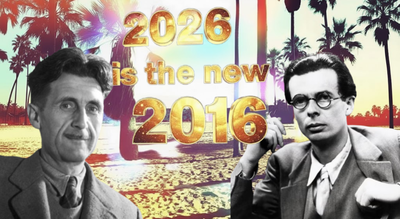
In 1949, shortly after the publication of Nineteen Eighty-Four, the British dystopian novel that remains widely read and relevant today, George Orwell received a letter from his former French teacher at Eton: Aldous Huxley. Huxley begins by praising the novel as “profoundly important,” but he quickly moves to a critical divergence. Orwell’s vision, he argues, relies too heavily on overt brutality, the “boot-on-the-face” model of power. Huxley doubted that such a system of control based on fear and constant surveillance could endure indefinitely. Instead, he predicted a quieter, more efficient, and far less wasteful form of domination, one in which people would willingly give up freedom, not because they are forced, but because they are distracted, comforted, and entertained. In this future, individuals are busy consuming, sharing, and indulging in convenient pleasures. They participate voluntarily, believing they are in control, while the system quietly shapes behaviour. Huxley suggested that this vision of subtle, self-imposed control would eventually come to pass, far surpassing Orwell’s depiction of the ever-watching, brutal state in Nineteen Eighty-Four and the overtly manipulative society he imagined inBrave New World. That distinction is crucial for understanding contemporary digital culture, and particularly the sudden resurgence of the “2026 is the new 2016” trend. In the opening weeks of 2026, social media platforms have been flooded with attempts to rewind the internet by a decade. Instagram, TikTok and X are saturated with hazy filters, deliberately degraded image quality, recycled visual cues and reposted artefacts from old camera rolls. Celebrities and influencers join in, uploading tour photos, selfies and lip-syncs soundtracked by mid-2010s pop. What initially appears as scattered nostalgia has crystallised into a recognisable online mood: a collective longing for an earlier version of the digital world.On the surface, the appeal seems straightforward. 2016 occupies a psychologically convenient distance, a full decade back, far enough to feel complete, but close enough to remain emotionally accessible in 2026. It predates the pandemic, the dominance of AI-generated content, and the current intensity of algorithmic optimisation. More importantly, it is remembered as a time when the internet felt less self-conscious, less engineered, and more communal. The trend presents itself as a retreat from the present: softer, messier, and more human. Yet this is precisely where Huxley’s warning becomes relevant. What the trend actually produces is not a rejection of the algorithmic present, but an extraordinarily rich dataset about users’ lives over the past decade. By encouraging people to dig through old photos, repost early posts, and narrate how much they have “grown,” platforms are not merely reviving an aesthetic, they are prompting users to voluntarily map their personal histories.
How nostalgia feeds the algorithm
1. It produces high-quality behavioural dataNostalgia changes how people behave online. Users do not scroll past a 2016 throwback in the same way they skim present-day content. They pause, rewatch, zoom in, read captions, check comments, and often share the post with someone who “was there at the time.” Each of these actions generates granular engagement data: dwell time, replay frequency, sharing patterns, and comment depth.From an algorithmic perspective, this data is unusually clean. It reflects genuine attention rather than idle scrolling. When millions of users interact with nostalgic content in similar ways, platforms gain highly reliable signals about what sustains engagement, far more valuable than likes alone.2. It trains algorithms on emotional patternsThe trend is not simply about recognising images from 2016; it is about measuring emotional response. Platforms can detect which nostalgic cues prompt warmth, longing, humour, sadness or reassurance, and how those emotions translate into sustained use.When the same songs, filters, phrases and visual styles consistently trigger deeper engagement across large populations, systems learn which emotional states are most effective at holding attention. Over time, this allows platforms to optimise not just for interest, but for mood, shaping feeds to elicit feelings that keep users returning.3. It reveals identity information voluntarilyWhen someone uploads a photo from 2016 alongside a current one, the system can infer age, life stage progression, changes in appearance, relationships, location, and emotional framing. When users caption these posts with reflections on who they were then versus now, they supply narrative context that no form field could ever capture. The algorithm does not just see an image; it sees development, stability, rupture, aspiration. Over millions of users, this creates a longitudinal dataset spanning an entire decade of human behaviour.Importantly, this information is not requested. There are no forms, no disclosures, no explicit consent. It is offered freely, framed as self-expression. Yet at scale, these disclosures allow platforms to map identity with extraordinary precision4. It accelerates predictive personalisationNostalgic data is particularly useful because it links past behaviour to present response. Platforms can see how users engage with memories, not just with new stimuli. This enables more accurate predictions about what will keep someone engaged in the future.Rather than recommending content based on what is beneficial or informative, systems prioritise what sustains attention. Nostalgia becomes a training ground for models designed to anticipate emotional vulnerability, familiarity bias, and comfort-seeking behaviour.5. It strengthens feedback loopsOnce the algorithm identifies that nostalgic content performs well, it surfaces more of it. Increased exposure leads to increased engagement, which further confirms the system’s assumptions. Users begin to see more throwbacks, respond emotionally, and reinforce the loop.Over time, this feedback cycle narrows the range of content users encounter, effectively creating an algorithmic echo chamber. Feeds become shaped not by curiosity or exploration, but by what the system knows will reliably keep users emotionally engaged. In Huxley’s terms, this represents a less arduous form of control: no content is banned, no behaviour is punished, yet the system quietly governs attention by surrounding users with what feels comforting and familiar, consolidating platform control without any overt restriction.6. It masks data extraction as resistanceThe trend often frames itself as a rejection of the modern internet: a longing for a time before hyper-optimised feeds and AI-generated content. This creates the illusion of resistance.In reality, participation does not weaken data collection. Every interaction, even one motivated by nostalgia or critique, still feeds the system. The feeling of opting out coexists with deeper extraction. As Huxley warned, control is most effective when people believe they are acting freely.7. It operates on a more powerful internet than 2016Although the aesthetic references 2016, the infrastructure processing it belongs to 2026. Today’s platforms possess far more advanced machine-learning systems, larger datasets, and more sophisticated behavioural models, many of which now explicitly integrate AI as a built-in feature of recommendation, moderation, and content ranking.The same actions that once produced limited insight now generate powerful predictive value. Nostalgic posts don’t stay confined to a single platform; they feed AI systems that cross-reference behaviour across apps and retrain models using the same patterns at scale. For instance, a user might post a video of a 2016 concert they attended alongside a current clip of themselves at a similar event. The system can then link their music preferences, travel habits, and social circles over time, creating a profile that predicts future interests and behaviours across multiple platforms. Individual social media activity builds a detailed personal profile that can be reused, refined, and applied across contexts, making the trend far more consequential than its nostalgic surface suggests.8. It normalises emotional surveillanceWhen people sign up to platforms, they agree to terms and conditions that are deliberately vague, and most barely read them. Users willingly share nostalgic posts, reflections on growth, or “then vs now” selfies, partly because it’s convenient: the apps make it easy to post, track likes, or measure their own engagement. Every click, reaction, or memory becomes a breadcrumb for algorithms to follow, shaping feeds, predicting behaviour, and targeting advertising. Platforms give users the illusion of control, they can see their own metrics, curate what they share, and feel like they are managing their online presence, without realising that every action is feeding the system. Over time, this constant, willing participation makes emotional surveillance feel normal, almost invisible, turning private feelings into data that can be measured, packaged, and monetised.9. It creates reusable insightsEven after a trend fades, platforms retain what they learn from users’ engagement: emotional triggers, identity markers, and behavioural patterns. These insights inform advertising strategies, political messaging, recommendation systems, and future cultural trends. By analysing which content resonates, algorithms can identify potential breakout posts, amplify them, and distribute them to the right audiences to maximise engagement. Because the system relies entirely on user-generated content, the ultimate goal is to keep users engaged for longer, making the platform feel more interesting while continuously training algorithms to predict and shape future behaviour at scale.10. It confuses comfort with safetyFamiliar aesthetics and throwback trends feel reassuring, offering a break from the chaos of the present. Users believe they are in control, choosing what to see and share. Yet this sense of comfort is deceptive. By encouraging repeated, predictable engagement, nostalgia makes users’ behaviour highly legible to algorithms. Every memory post, caption, or reaction strengthens the platform’s understanding of what keeps attention, what drives sharing, and what emotions can be triggered next. The trade-off is subtle: feeling safe masks how easily behaviour can be tracked and influenced.
Your memories power the system
As the nostalgia trend unfolds, it becomes clear that its appeal is not simply aesthetic. Users participate voluntarily, sharing old photos, videos, and memories, often under the guise of self-expression or playful reflection. No authority compels them to do so, engagement feels natural, even resistant. Yet every interaction contributes to a broader system: the platform learns, models, and predicts behaviour with ever-increasing precision.Huxley foresaw this exact dynamic. In his view, control need not rely on fear or overt coercion if people can be persuaded to enjoy the systems that govern them. The “2026 is the new 2016” trend exemplifies that subtle form of influence. It disguises data extraction as self-expression, frames emotional disclosure as authenticity, and uses the convenience of participation to quietly build detailed behavioural profiles.In this sense, the trend is not a return to 2016 at all. It operates on a far more advanced, extractive, and predictive internet than the one it nostalgically evokes. What feels like looking back is, in reality, feeding forward, allowing platforms to anticipate desires, shape attention, and influence behaviour at scale.Orwell warned us about being watched. Huxley warned us about enjoying it. As he wrote, “I believe that the world’s rulers will discover that infant conditioning and narco-hypnosis are more efficient, as instruments of government, than clubs and prisons, and that the lust for power can be just as completely satisfied by suggesting people into loving their servitude as by flogging and kicking them into obedience.” In other words, constant surveillance isn’t needed: users will willingly share their past selves and personal details if persuaded by convenience, entertainment, or social rewards, effectively feeding platforms everything they need to map, predict, and monetise behaviour.
Author

harrywilliams031@gmail.com
Related Posts

Boston.com에서 겨울 폭풍 사진과 비디오를 공유하세요
우리에게 말해주세요 일요일부터 월요일까지 눈이 내릴 가능성이 있습니다. 뉴잉글랜드를 통과하는 허리케인의 최고의 사진을 Boston.com에 제출하세요. 사람들이 2026년 1월 19일 보스턴의 아놀드 수목원에서...
Read out all
TipRanks에서 측정한 2025년 상위 10명의 분석가
VCG | 비주얼차이나그룹 | 게티 이미지 월스트리트 분석가는 연구와 유용한 통찰력으로 투자자를 안내하지만, 일부는 강력하고 정확한 판단으로 지속적으로 다른 분석가보다 뛰어난 성과를...

NSF EPSCOR 연구원 근무 시간
미국 국립과학재단(National Science Foundation)이 경쟁력 있는 연구를 장려하기 위해 설립한 프로그램인 NSF EPSCOR는 NSF EPSCOR 연구 인프라 개선 프로그램: EPSCOR Research Fellows(ERF)에...
Read out all
De Minaur, 호주 오픈 알카라즈 경기 준비
1월 25일, 멜버른 Alex de Minaur는 일요일 연속 Australian Open 8강에 진출했지만 6번째 시드는 그가 꿈의 Melbourne Park 달리기를 계속하기 위해 이제...
Read out all
눈이 왜 미끄러운지는 아무도 모릅니다.
그들은 표면 근처의 분자가 얼음 내부의 분자와 다르게 행동한다는 것을 발견했습니다. 얼음은 결정체입니다. 이는 각 물 분자가 주기적인 격자에 갇혀 있음을 의미합니다....
Read out all
Simmons Says – A look at Auston Matthews and his Maple Leaf captaincy
Breadcrumb Trail Links Sports Get the latest from Steve Simmons straight to your inbox Sign Up Published Jan 25, 2026 • Last...
Read out all