I. Overview
On May 20, 2024, OSHA published a final rule updating and revising its Hazard Communication Standard (HCS) (89 FR 44144). The final rule became effective on July 19, 2024. On October 9, 2024, the agency issued a corrections notification and technical amendment to correct errors in that final rule which the agency believed could lead to confusion during the classification process or errors on labels and Safety Data Sheets (SDSs) if not expeditiously corrected (89 FR 81829). Following publication of the October 9, 2024 corrections notification and technical amendment, OSHA continued its review of the final rule and identified additional minor and typographical errors in the regulatory text and appendices to the HCS. OSHA is issuing this correction document to address these additional minor errors which occur in paragraphs (c) and (d) of the regulatory text and in Appendices A, B, C, D, and F. These corrections reflect the agency’s intent for the provisions of the final rule as explained in the preamble to the final rule. Some of these corrections are explained in the following discussion, and the table provided at the end of this section summarizes all the corrections included in this document.
Four of the corrections are to paragraph (c) of the regulatory text and one of the corrections is to paragraph (d) of the regulatory text. These corrections add the heading “Definitions” to the beginning of paragraph (c), add “chemicals under pressure” to the definition of “Physical hazard,” correct the formatting of the text of “area” in the definition of “Work area” to match the formatting for other terms, and correct the definition for “Liquid”, which inadvertently did not include the conversion of 14.69 PSI for all references to vapor pressure. OSHA is also adding the heading “Hazard Classification” to paragraph (d), which was inadvertently omitted from the 2024 final rule.
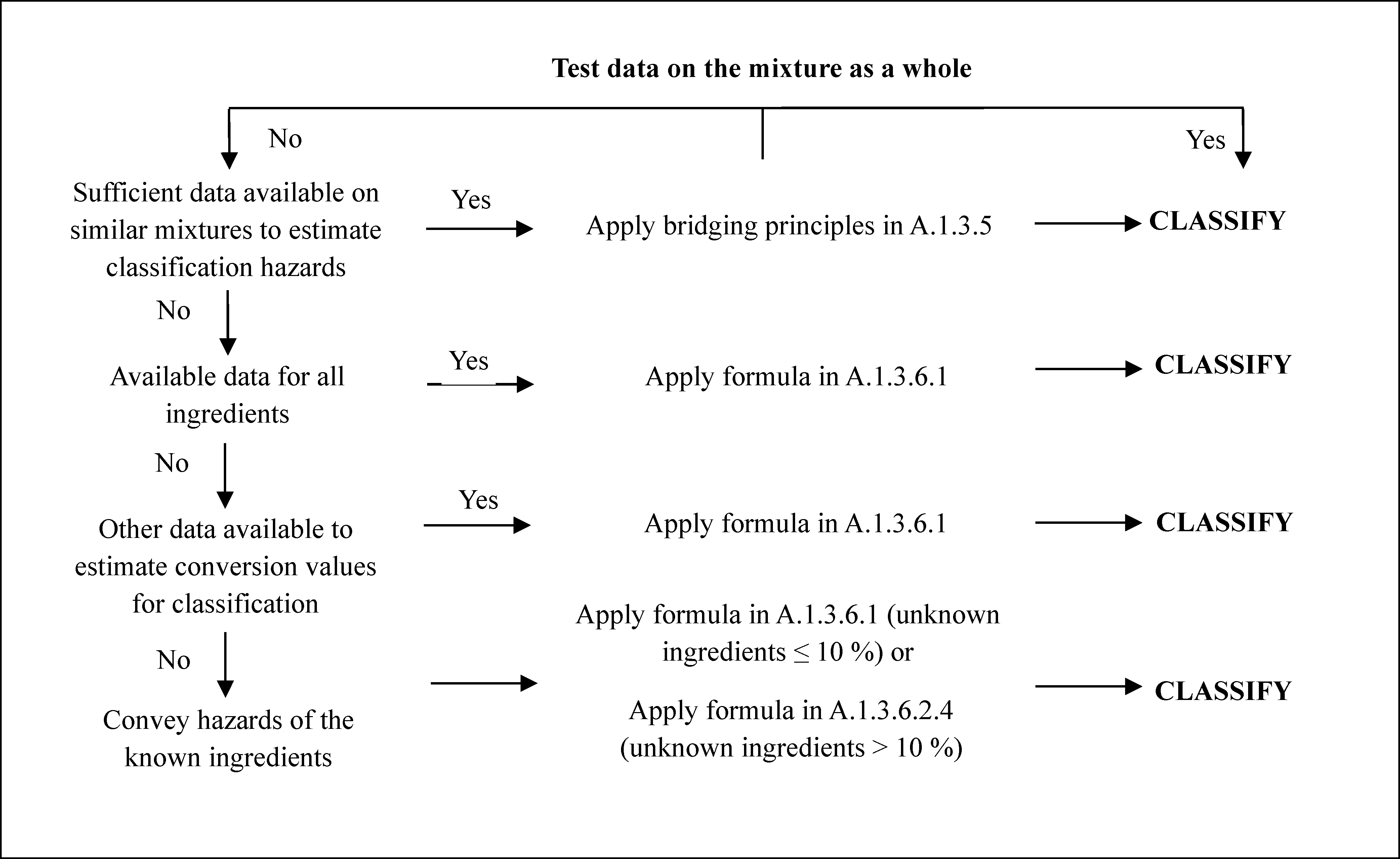
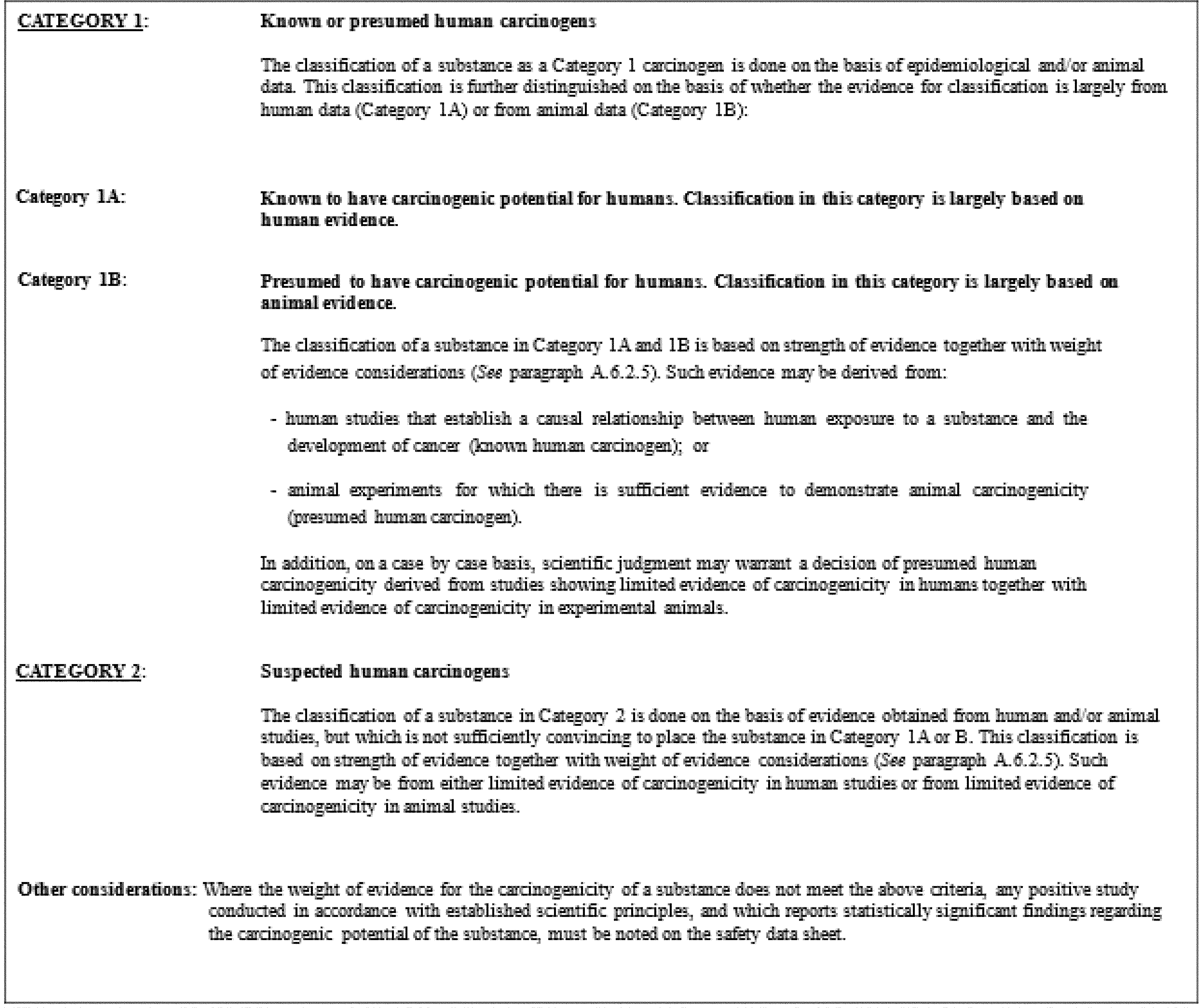
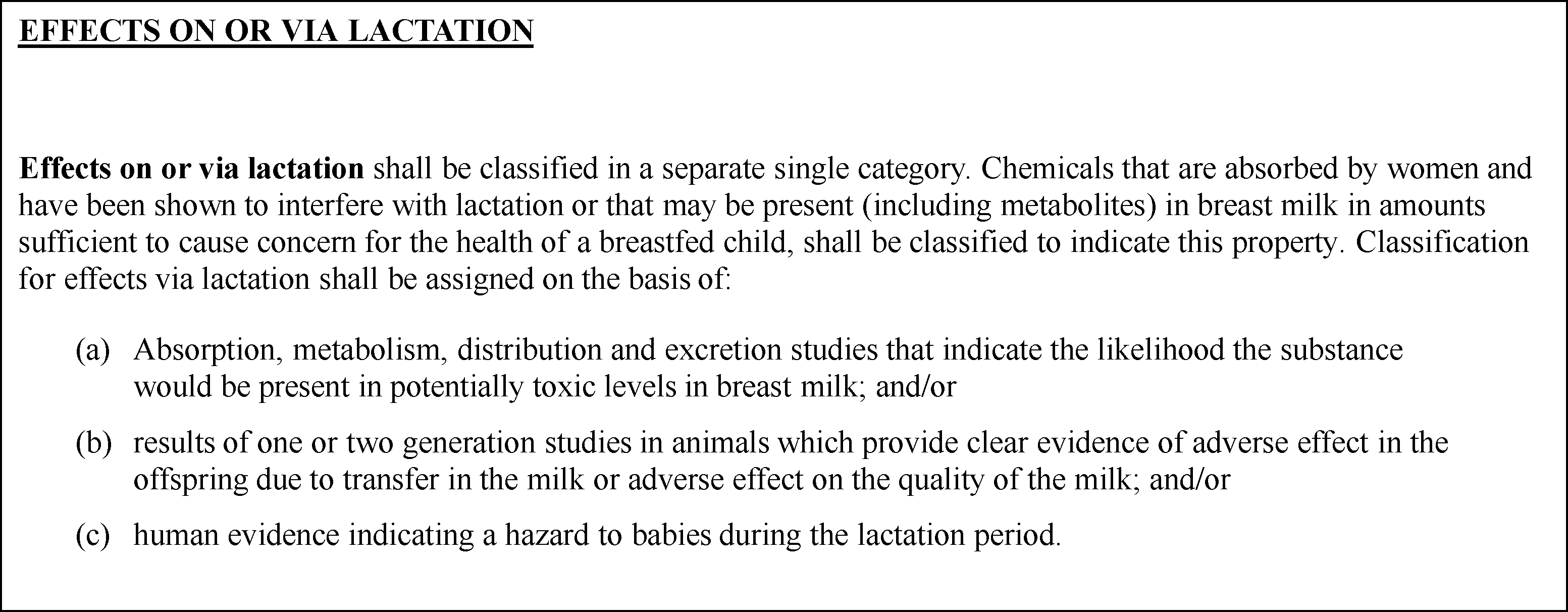
The remainder of the errors corrected in this document are in the Appendices. For instance, in Appendix A, OSHA is correcting the reference within Figure A.1.1 which currently reads “apply formula in A.1.3.6.3” to “apply formula in A.1.3.6.4” to cross reference the correct paragraph. OSHA is also deleting elements that are in the GHS which were inadvertently included in the final rule but are not appropriate for OSHA’s standard. These include statements such as “which can be used by those authorities requiring more than one designation for corrosivity” and “where sub-categorization is not required by a competent authority or” in paragraph A.2.2(a) and references to tables that do not appear in the HCS. OSHA is correcting figures A.6.1, A.7.1(a), A.7.1(b) and A.8.1, which were inadvertently altered in the final rule, and is replacing these figures with the versions of the figures included in the February 16, 2021 notice of proposed rulemaking (86 FR 9576). The agency received no comments on the proposed changes for Figure A.7.1(b) and intended to adopt them in the final rule. OSHA did not propose changes for the other figures.
In Appendix B, OSHA is correcting several errors in spelling and numbering in tables and text, as well as errors in the designations of several footnotes in Appendix B. In addition, OSHA is updating Note 2 for both Table B.3.1 and B.3.2 to follow the same format, to add “including their labeling elements” to be consistent with the GHS, and to correct cross references to other portions of Appendix B which were inadvertently omitted or numbered incorrectly. OSHA is also updating a footnote in each of Tables B.2.1, B.5.1, B.6.1 and B.7.1 by adding “chemicals under pressure.” This will align these footnotes with the text in Note 2 of Table B.3.2 regarding how chemicals under pressure should be classified.
In Appendix C, OSHA is correcting minor formatting errors in several places, such as italicizing, bolding, or
( printed page 563)
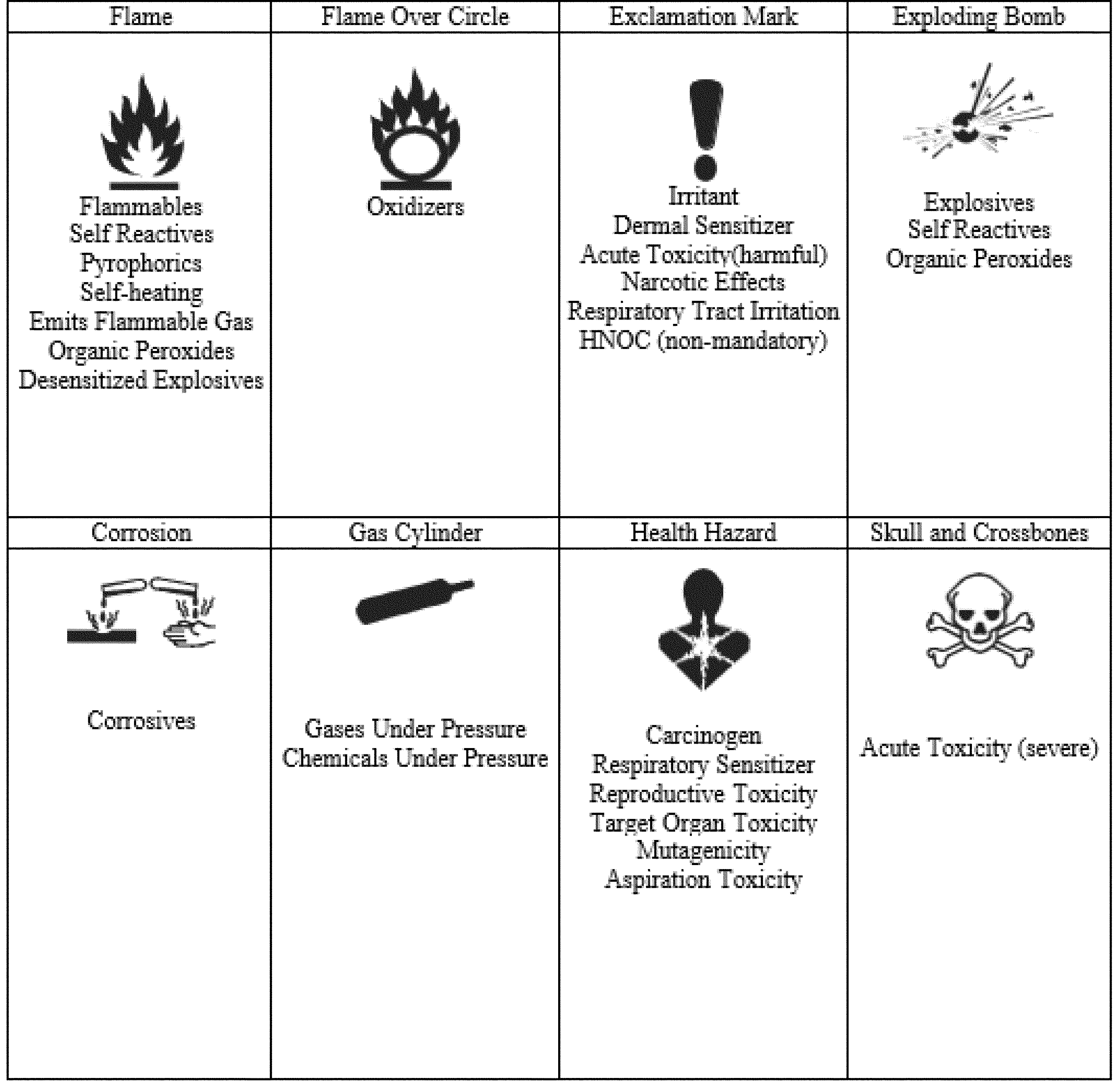
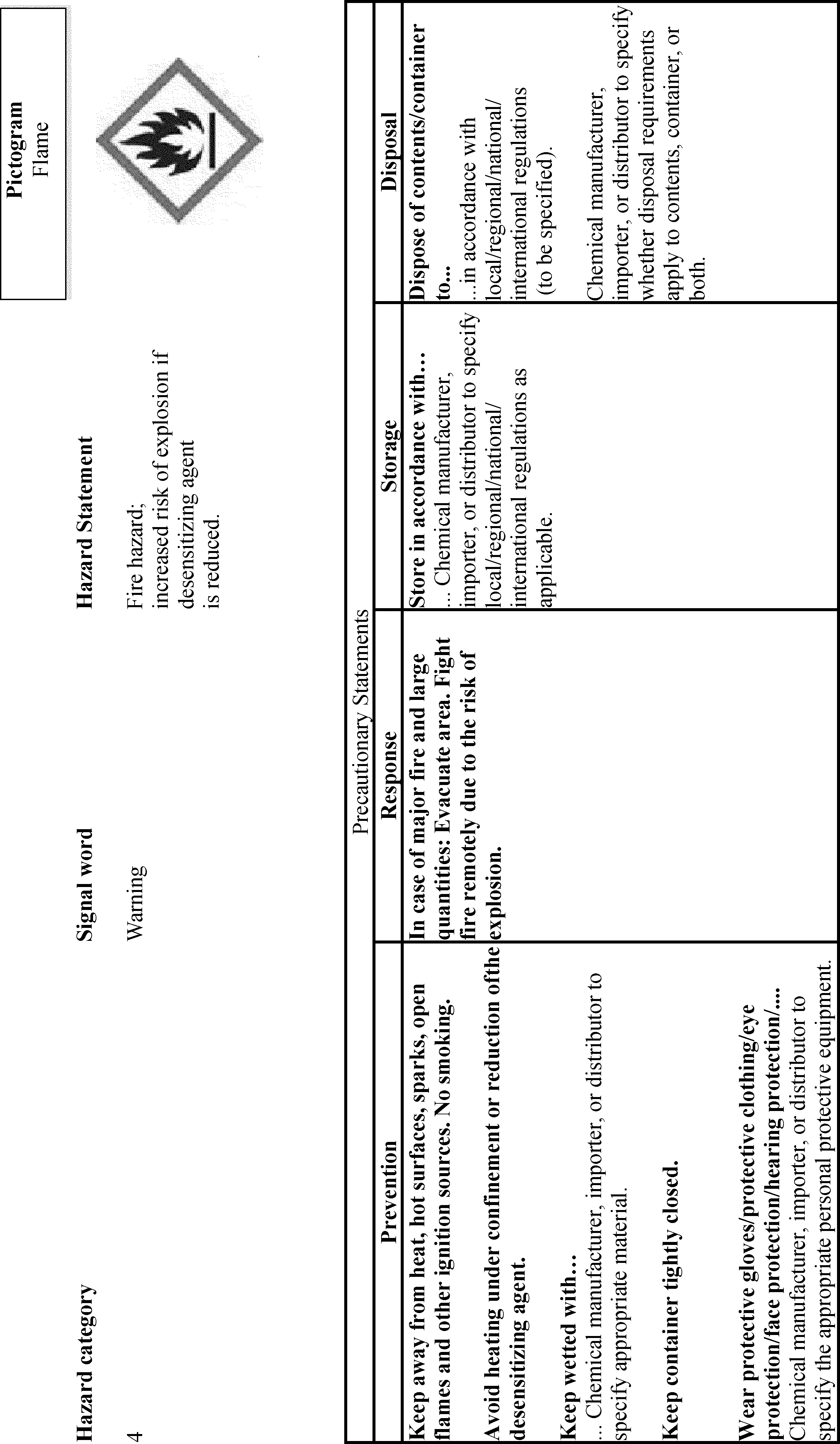
un-bolding font and removing slashes that were inadvertently included. Additionally, OSHA is adding “Chemicals Under Pressure” to Figure C.1. This was inadvertently omitted from the list of hazard classes associated with the Gas Cylinder hazard symbol. OSHA is also updating the text of C.2.4.6 to use the updated version of the example precautionary statement. OSHA is also making a number of corrections related to Table C.4.16, including adding the precautionary statement “In case of fire: Use . . . to extinguish” and its associated explanatory note to the “Response” column of Chemical Under Pressure (Hazard Category 1 and 2). The latter change will accomplish OSHA’s stated intention to align with the GHS Rev. 8 (89 FR 44324). In Table C.4.19, OSHA is removing the phrase “Chemical manufacturer, importer, or distributor to specify applicable ignition source(s),” which it inadvertently failed to delete in this table after updating the precautionary statement to include all ignition sources (see 89 FR 44336). The agency is also adding the words “and large quantities” in C.4.30, which were inadvertently omitted from the Hazard Category 4 Response precautionary statement.
In Appendix D, OSHA is correcting typographical errors in Section 2 and Section 7. Also in Appendix D, OSHA is correcting the Section 2(a) cross-reference from (d)(1)(i) to (d)(1). This correction ensures that Appendix D clearly conveys the requirements for providing the hazard classification of a chemical in Section 2. As OSHA noted in the preamble to the 2024 final rule, the agency intended to require hazards associated with chemicals as shipped and hazards associated with a change in the chemical’s physical form to be presented in Section 2(a), and hazards created by a chemical reaction to be presented in Section 2(c) (89 FR 44344). Finally, OSHA is removing the phrases “methods specified under” and “and then listed on the SDS” from the note to Table D.1 to align that language with the footnote in Appendix B as OSHA stated it would in the HCS 2024 final rule (89 FR 44350).
OSHA is also making one technical amendment unrelated to the 2024 final rule. In Appendix F, the agency is revising the first sentence of the section titled “Responses Are in One Sex or Both Sexes” to use the term “sex-specific tumors” rather than “gender-specific tumors.” A complete list of changes can be found below.
The following standards appear in the amendatory text of this document and were previously approved for the locations in which they appear: ADR 2019, ASTM D 4359-90, ASTM D 240-02, ISO 13943, NFPA 30B.
Correction of Publication
The following table contains a complete list of the corrections being made in this corrections notification and technical amendment to the Hazard Communication Standard final rule as it appeared at 89 FR 44144, unless otherwise noted, and provides a summary of each correction. The changes are listed by the
Federal Register
page number on which they can be found.
| Page No. | Standard | Correction or technical amendment |
|---|---|---|
| On p. 44356 | § 1910.1200, paragraph (c) | Add the paragraph (c) heading “Definitions.” before the definition for Article. |
| On p. 44357 | § 1910.1200, paragraph (c) | Update the definition of liquid to include the PSI conversion (14.69 PSI) with the first reference to the value 101.3 kPa. |
| On p. 44357 | § 1910.1200, paragraph (c) | Update the definition of “Physical hazard” to include “chemicals under pressure”. |
| On p. 44357 | § 1910.1200, paragraph (c) | Italicize the term “Work area”. |
| On p. 44357 | § 1910.1200, paragraph (d) | Add the heading “Hazard classification.” to paragraph (d). |
| On p. 44363 | § 1910.1200, Appendix A, Figure A.1.1 | Change “Apply formula in A.1.3.6.2.3” to “Apply formula in A.1.3.6.2.4”. |
| On p. 44364 | § 1910.1200, Appendix A, A.2.2(a) | Delete “which can be used by those authorities requiring more than one designation for corrosivity” in the first paragraph and “where sub-categorization is not required by a competent authority or” in the second paragraph. |
| On p. 44365 | § 1910.1200, Appendix A, A.2.2.3.3.1 | Delete “based on the criteria in Table A.2.6” at the end of the paragraph. |
| On p. 44365 | § 1910.1200, Appendix A, A.2.2.3.4.1 | Delete “based on the criteria in Table A.2.7” at the end of the paragraph. |
| On p. 44376 | § 1910.1200, Appendix A, Figure A.6.1 | Replace Figure A.6.1 with the version published in the February 16, 2021 NPRM (86 FR 9745-9746).1 |
| On p. 44377 | § 1910.1200, Appendix A, Figure A.7.1(a) | Replace Figure A.7.1(a) with the version published in the February 16, 2021 NPRM (86 FR 9747). |
| On p. 44377-44378 | § 1910.1200, Appendix A, Figure A.7.1(b) | Replace Figure A.7.1(b) with the version proposed in the February 16, 2021 NPRM (86 FR 9577). |
| On p. 44380 | § 1910.1200, Appendix A, Figure A.8.1 | Replace Figure A.8.1 with the version published in the February 16, 2021 NPRM (86 FR 9750). |
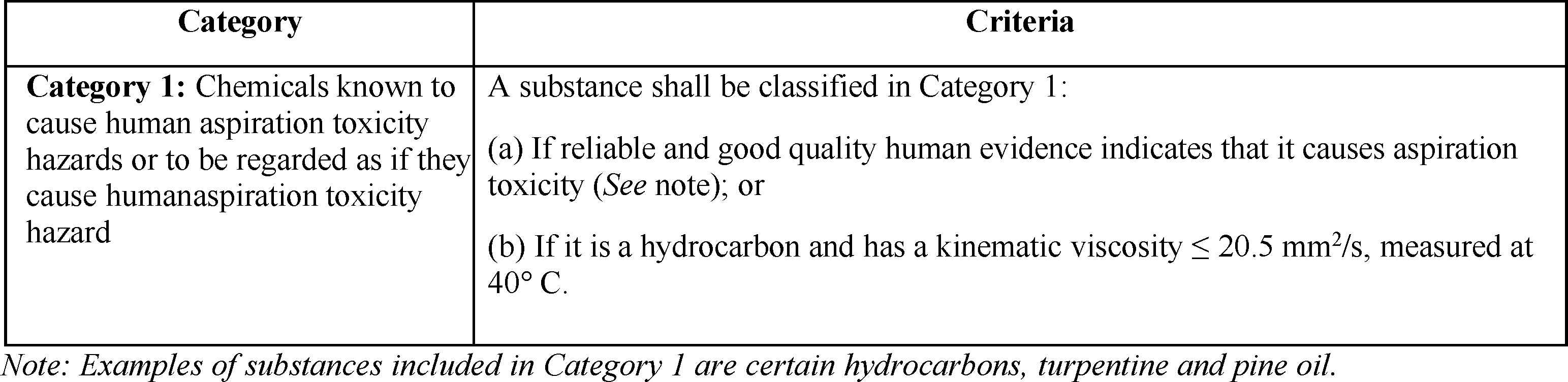
| On p. 44386 | § 1910.1200, Appendix A, Table A.10.1 | In the criteria section, change the unit on “≤20.5 mm 2 /s” to “≤20.5 mm2 /s”. |
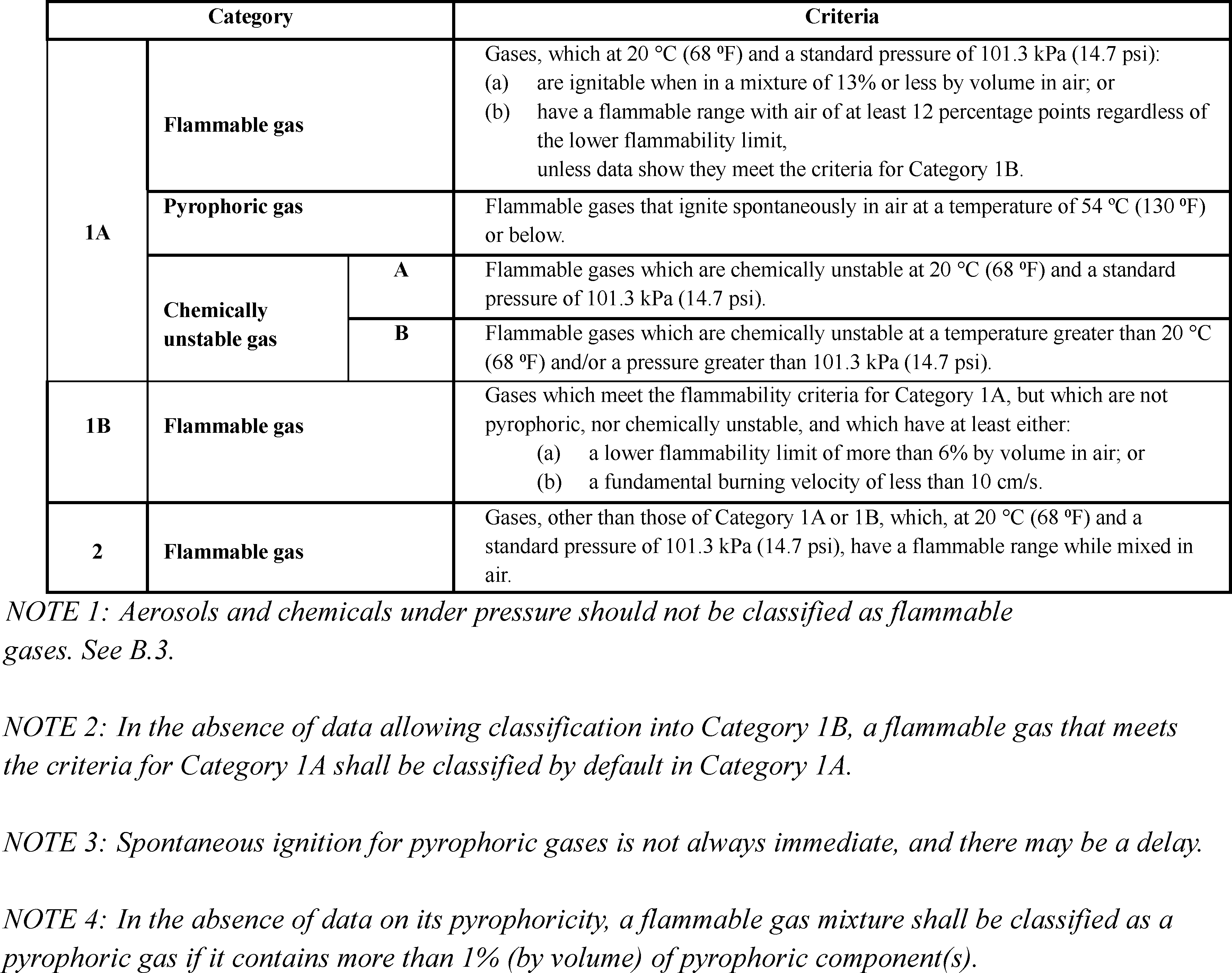
| On p. 44387 | § 1910.1200, Appendix B, Table B.2.1 | Change the Note 1 from “Aerosols should not be classified as flammable gases.” to “Aerosols and chemicals under pressure should not be classified as flammable gases.” |
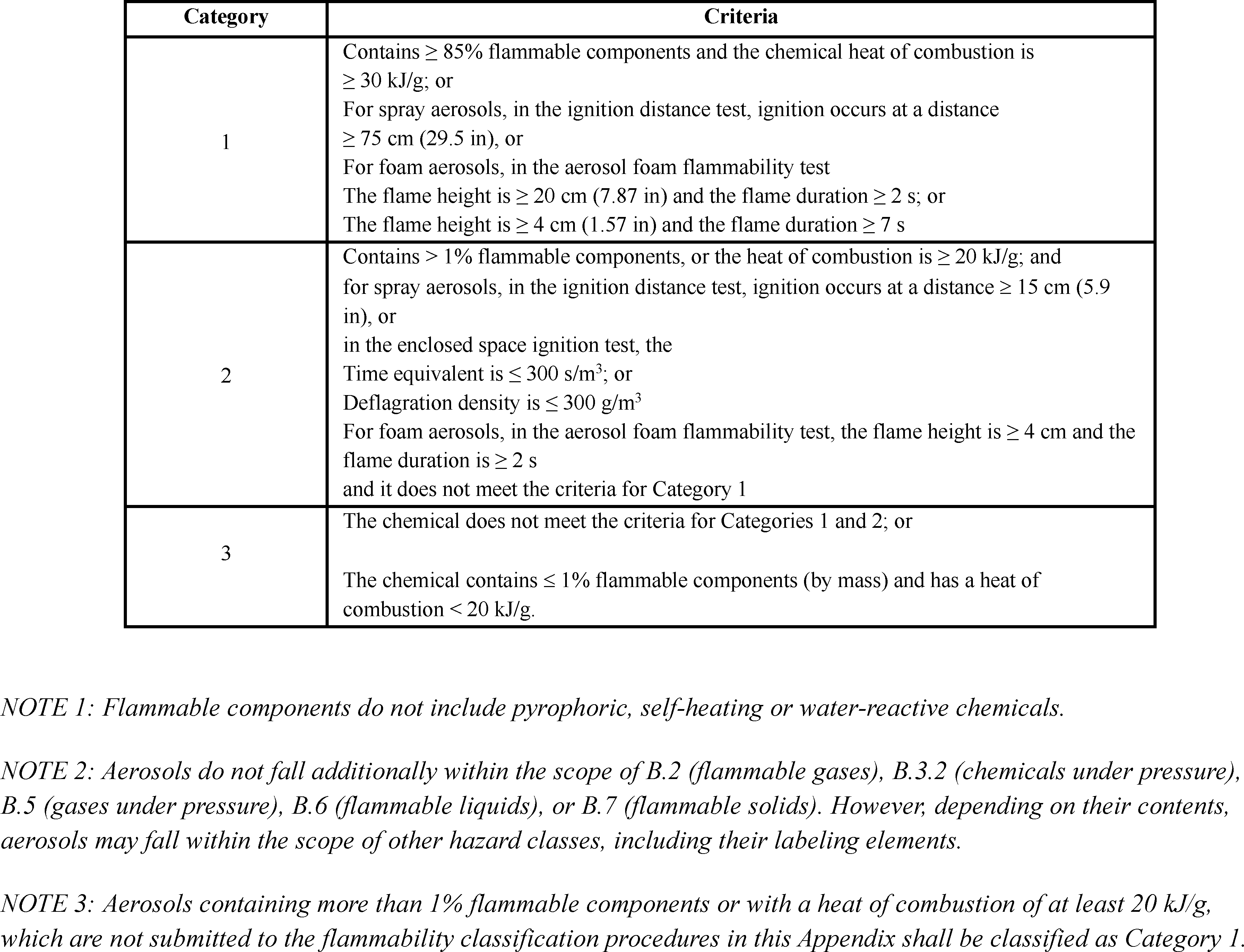
| On p. 44388 | § 1910.1200, Appendix B, Table B.3.1 | Change Note 2 from “Aerosols do not fall additionally within the scope of flammable gases, gases under pressure, flammable liquids, or flammable solids. However, depending on their contents, aerosols may fall within the scope of other hazard classes.” to now read “Aerosols do not fall additionally within the scope of B.2 (flammable gases), B.3.2 (chemicals under pressure), B.5 (gases under pressure), B.6 (flammable liquids), or B.7 (flammable solids). However, depending on their contents, aerosols may fall within the scope of other hazard classes, including their labeling elements.” |
|
( printed page 564) |
||
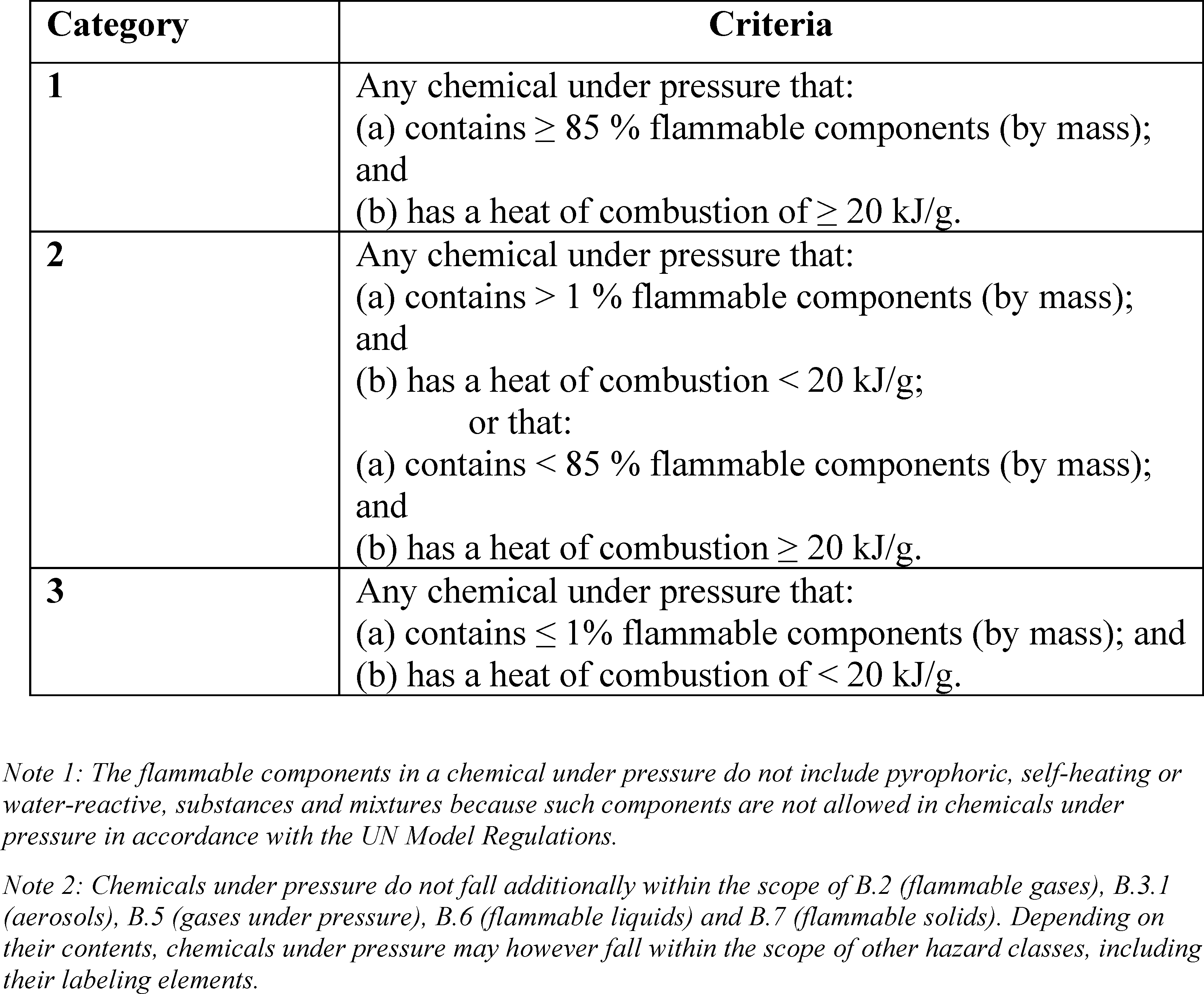
| On p. 44388 | § 1910.1200, Appendix B, Table B.3.2 | Change Note 2 from “Chemicals under pressure do not fall additionally within the scope of section B.3.1 (aerosols), B.2.2 (flammable gases), B.2.5 (gases under pressure), B.2.6 (flammable liquids) and B.2.7 (flammable solids). Depending on their contents, chemicals under pressure may however fall within the scope of other hazard classes, including their labelling elements.” to now read “Chemicals under pressure do not fall additionally within the scope of B.2 (flammable gases), B.3.1 (aerosols), B.5 (gases under pressure), B.6 (flammable liquids) and B.7 (flammable solids). Depending on their contents, chemicals under pressure may however fall within the scope of other hazard classes, including their labeling elements.”. |
| On p. 44389 | § 1910.1200, Appendix B, B.3.3.3 | Change “see ASTM D240” to “see ASTM D240-02”. |
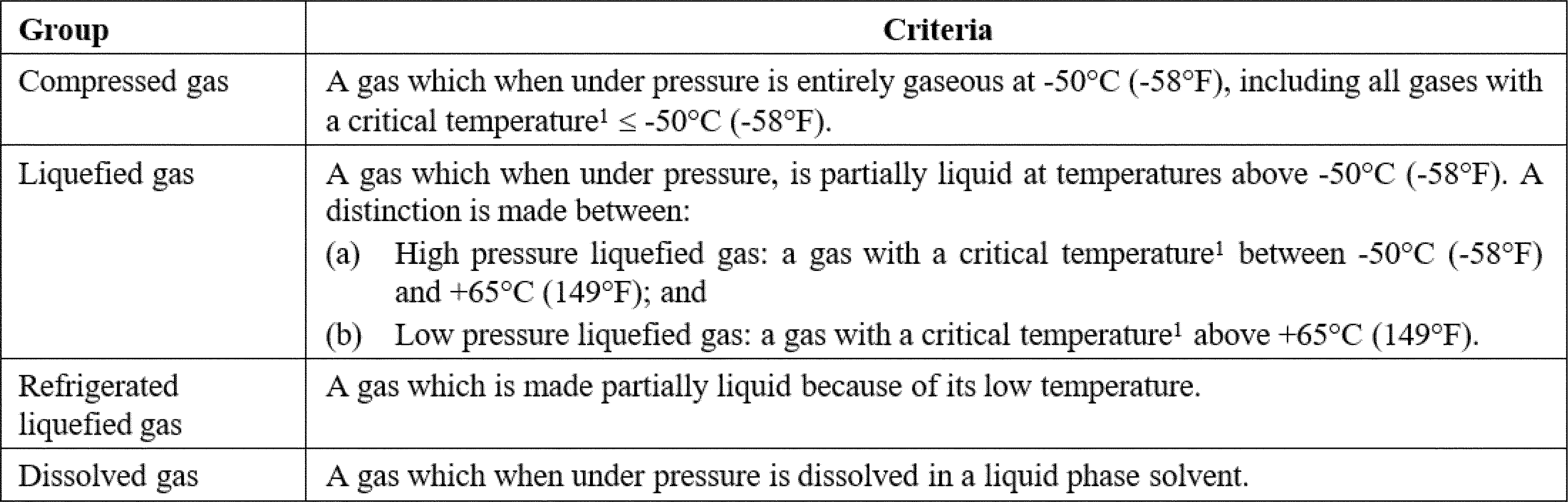
| On p. 44389 | § 1910.1200, Appendix B, Table B.5.1 | In the “Group” column, change “Liquedfied gas” to “Liquefied gas”. In the “Criteria” column, change “inder” to “under” in the first line. |
| In the “Criteria” column, change “inder” to “under” in the third line. | ||
| In the “Criteria” column, change “disinction” to “distinction” in the fourth line. | ||
| In the “Criteria” column, change “termperatures” to “temperatures” in line 3 and “termperature” to “temperature” in line 6. | ||
| Change the Note from “Aerosols should not be classified as gases under pressure. See Appendix B.3 of this section.” to “Aerosols and chemicals under pressure should not be classified as gases under pressure. See Appendix B.3 of this section.” | ||
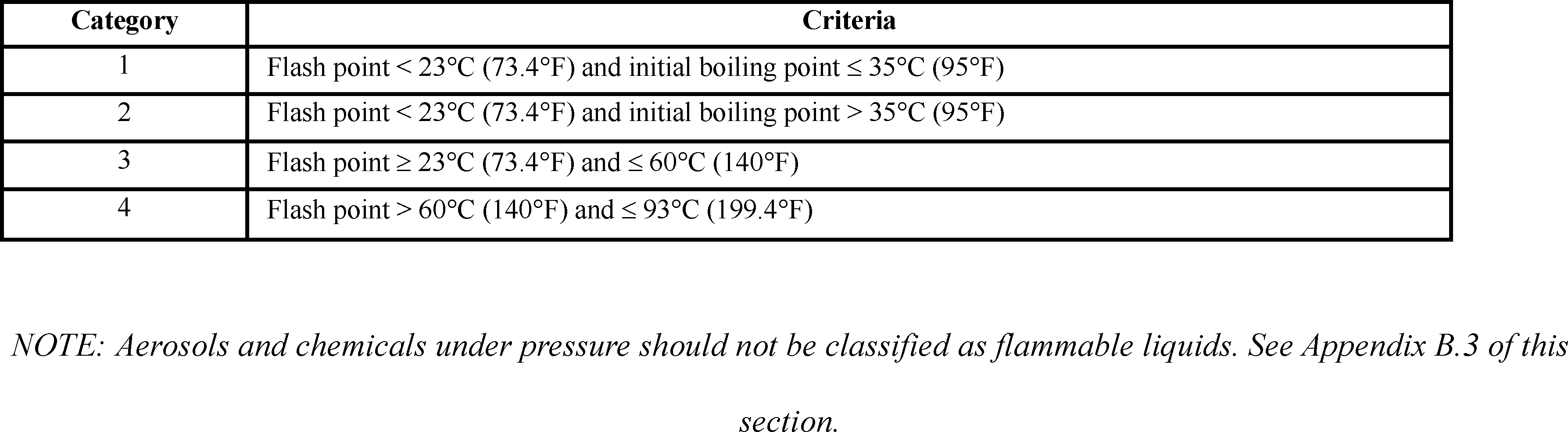
| On p. 44389 | § 1910.1200, Appendix B, Table B.6.1 | Change the Note from “Aerosols should not be classified as flammable liquids. See Appendix B.3 of this section.” to “Aerosols and chemicals under pressure should not be classified as flammable liquids. See Appendix B.3 of this section.” |

| On p. 44390 | § 1910.1200, Appendix B, Table B.7.1 | Change Note 2 from “Aerosols should not be classified as flammable solids. See Appendix B.3.” to “Aerosols and chemicals under pressure should not be classified as flammable solids. See Appendix B.3 of this section.” |
| On p. 44390, 44394 | § 1910.1200, Appendix B, Footnotes | Redesignate Appendix B footnotes 9, 10, and 11 as footnotes 1, 2, and 3, respectively. |
| On p. 44395 | § 1910.1200, Appendix C, Figure C.1 | In column 2 row 4, add “Chemicals Under Pressure” to the list of hazard classes associated with the Gas Cylinder hazard symbol. |
| On p. 44396 | § 1910.1200, Appendix C, C.2.4.6 | Replace C.2.4.6 to now read “C.2.4.6 Precautionary statements may be combined or consolidated to save label space and improve readability. For example, “Keep cool” and “Keep away from heat, hot surfaces, sparks, open flames and other ignition sources. No smoking.” can be combined to read “Keep cool and away from heat, hot surfaces, sparks, open flames and other ignition sources. No smoking.” ” |
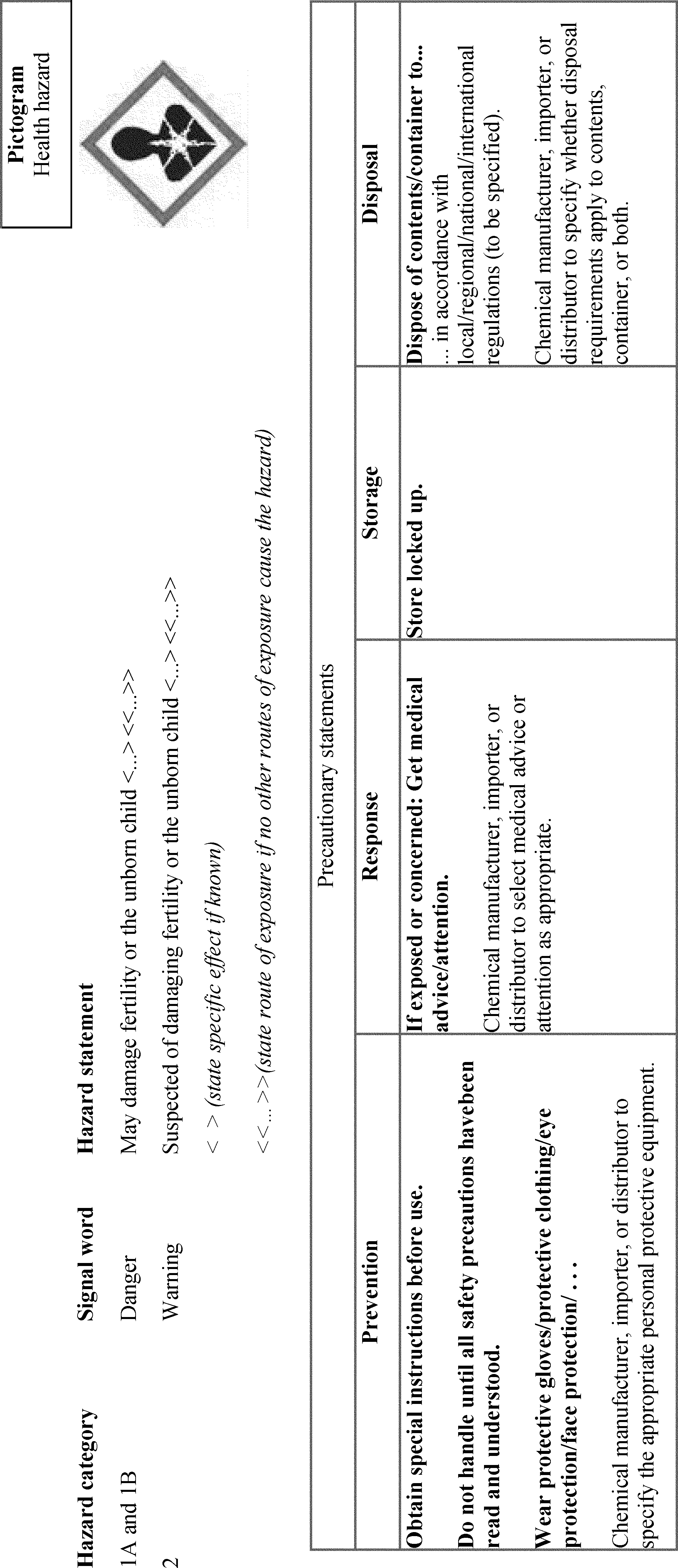
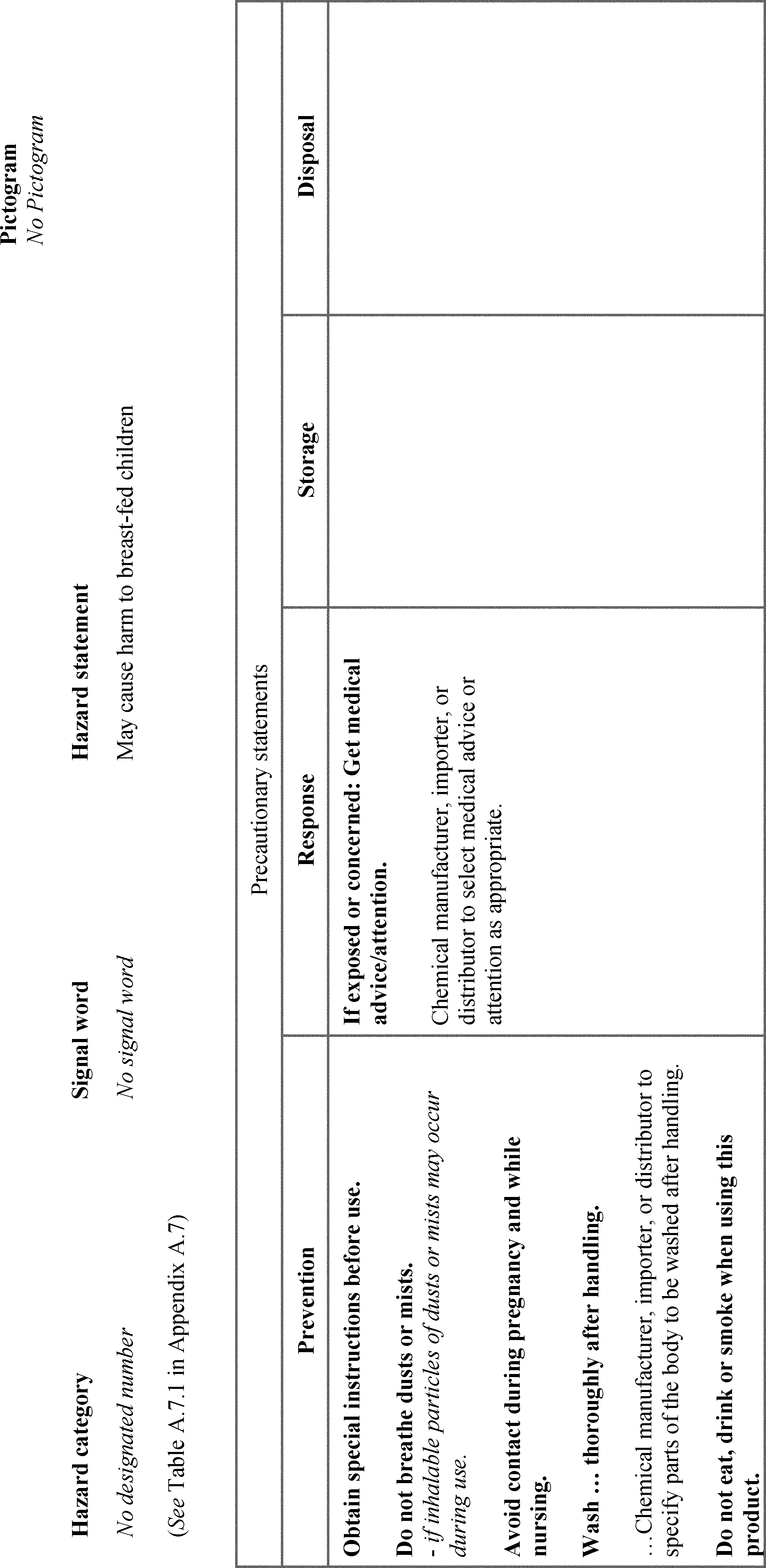
| On p. 44415 | § 1910.1200, Appendix C, C.4.10 | Under the Prevention column for the no designated number hazard category (Effects on or Via Lactation), remove the slash “/” from “Avoid contact during pregnancy and/while nursing” in the fifth line. |
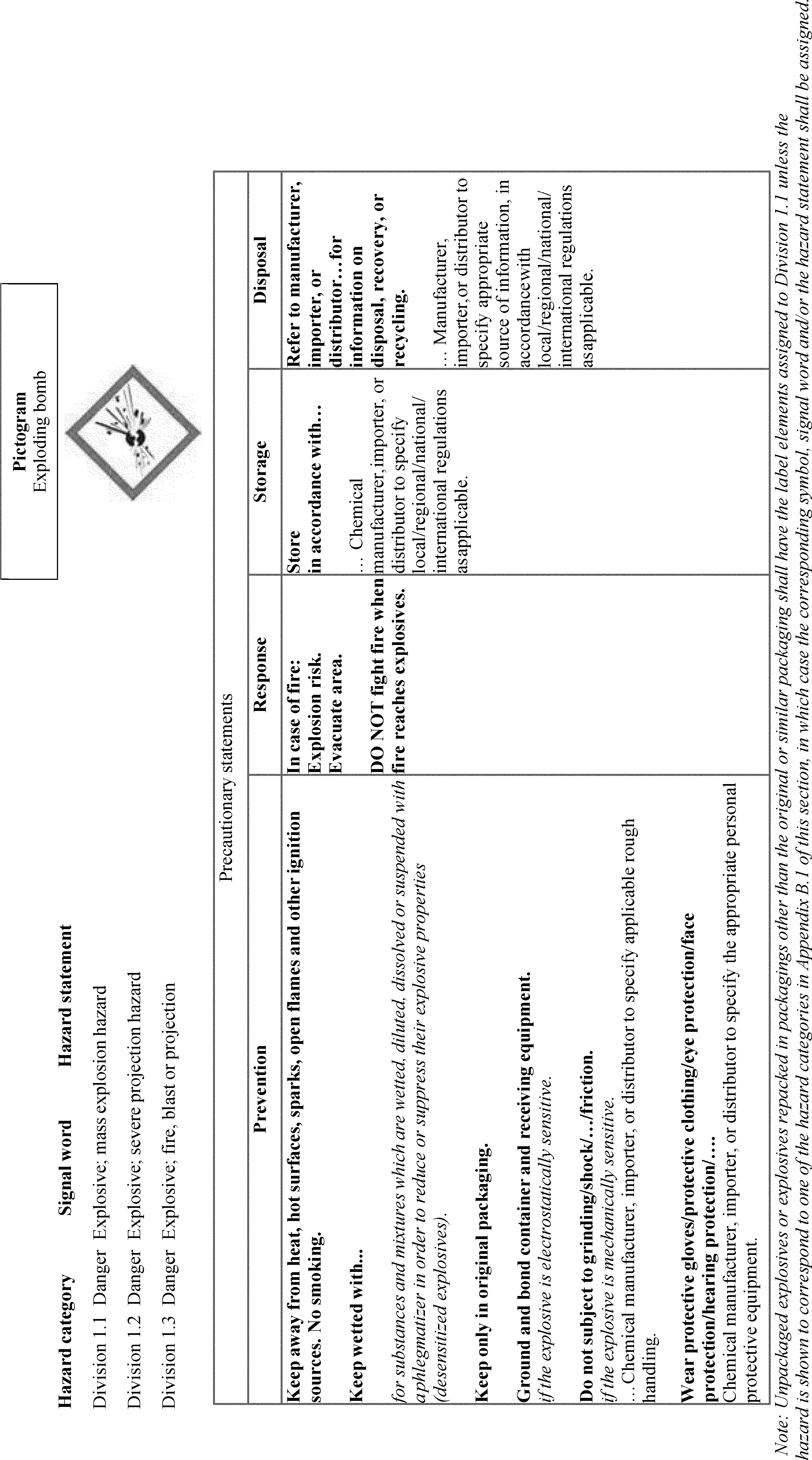
| On p. 44423 | § 1910.1200, Appendix C, C.4.14 | For Hazard category Divisions 1.1, 1.2, and 1.3, in the Prevention column, remove the “/” from “Ground and/bond container and receiving equipment.” in line eight. |
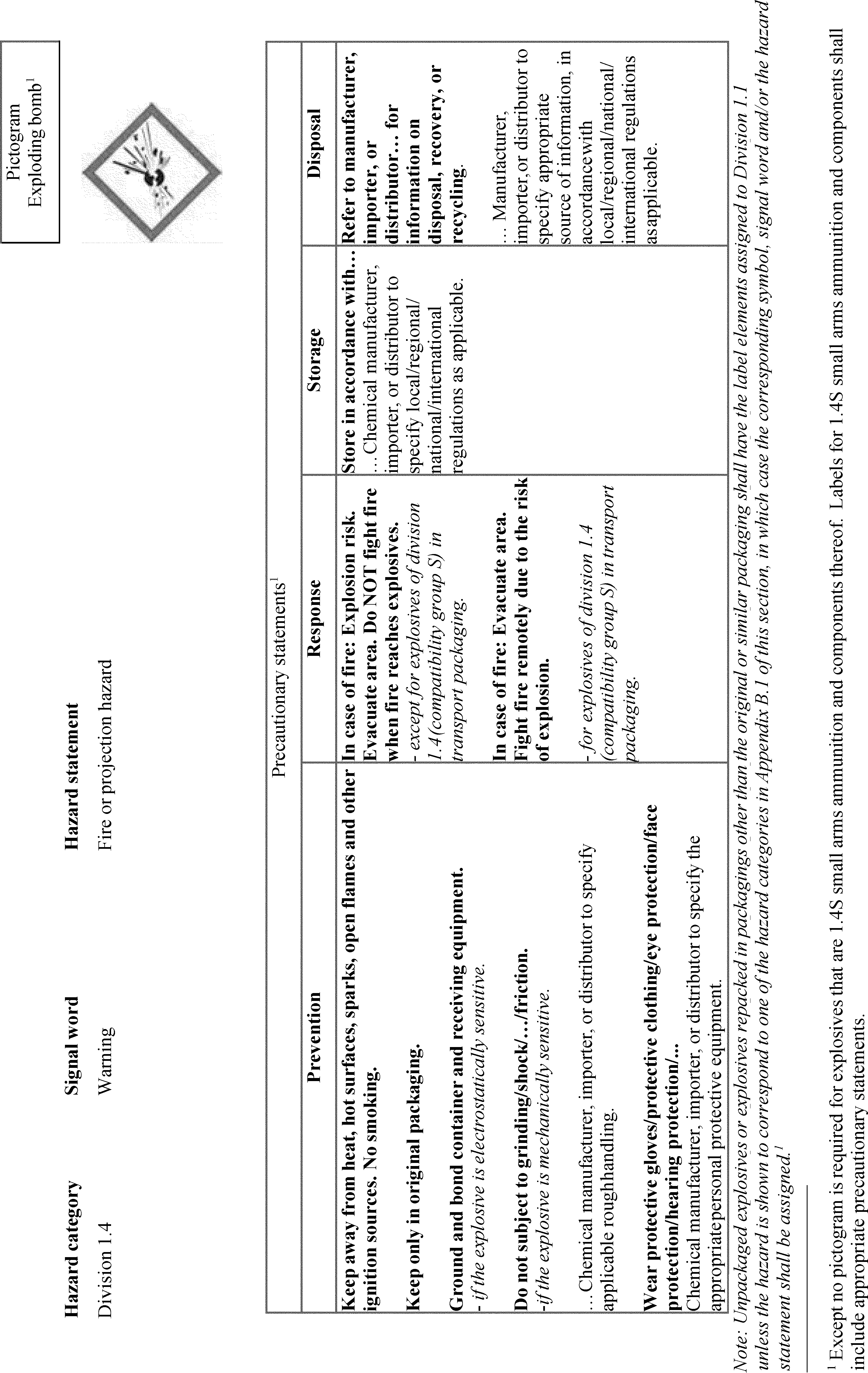
| On p. 44424 | § 1910.1200, Appendix C, C.4.14 | For Hazard category Division 1.4, in the Prevention column, remove the “/” from “Ground and/bond container and receiving equipment.” in line four. |
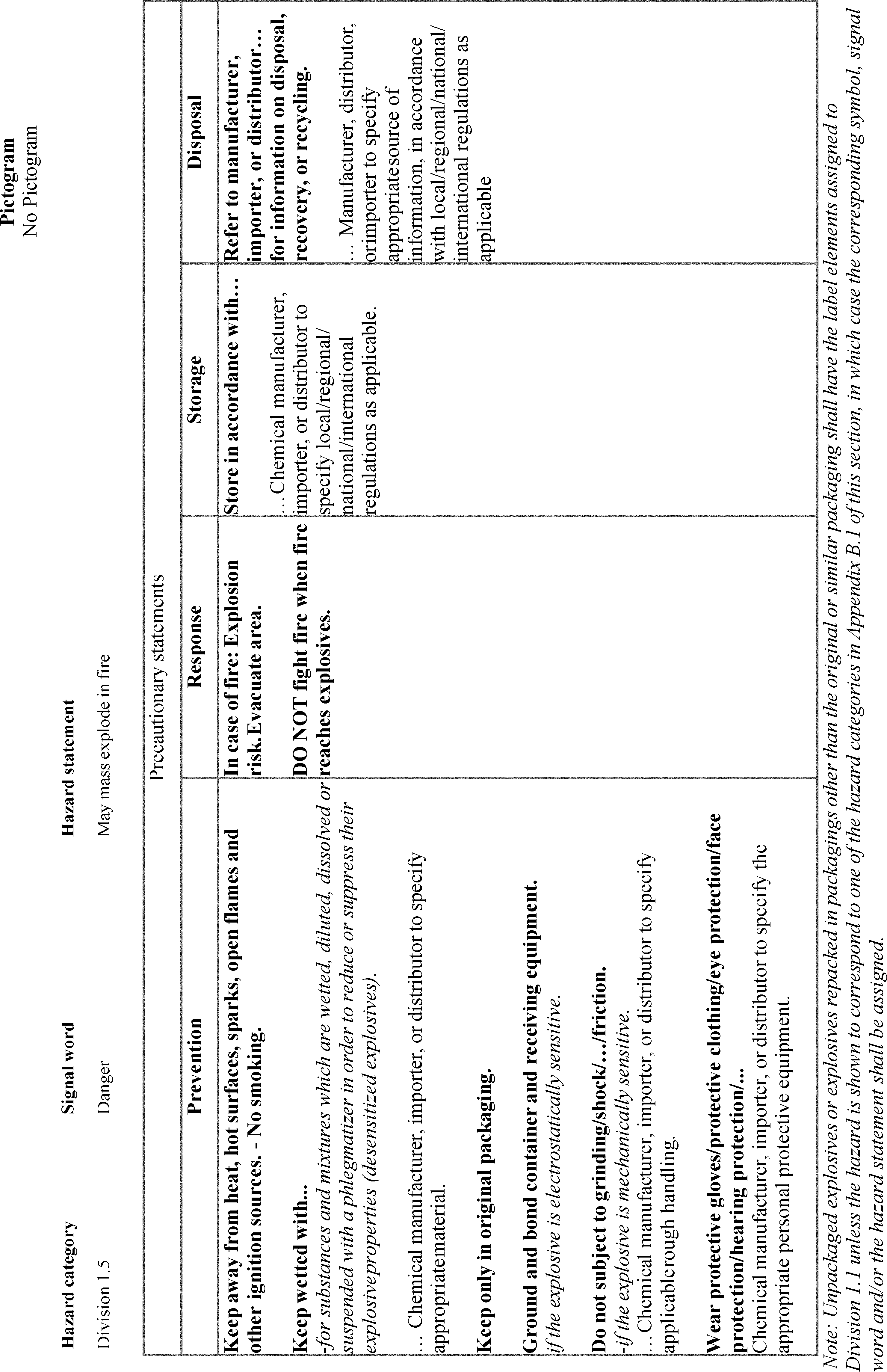
| On p. 44425 | § 1910.1200, Appendix C, C.4.14 | For Hazard category Division 1.5, in the Prevention column, remove the “/” from “Ground and/bond container and receiving equipment.” in line ten. |
| On p. 44425 | § 1910.1200, Appendix C, C.4.14 | For Hazard category Divisions 1.1, 1.2, and 1.3, in the Storage column remove the ellipsis from the middle of the precautionary statement “Store . . . in accordance with . . .” in line 1 so that it now reads “Store in accordance with . . .”. |
| On p. 44424 | § 1910.1200, Appendix C, C.4.14 | For Hazard category Division 1.4, in the Storage column remove the ellipsis from the middle of the precautionary statement “Store . . . in accordance with . . .” in line 1 so that it now reads “Store in accordance with . . .”. |
| On p. 44431-44433 | § 1910.1200, Appendix C, C.4.16 | Under the Prevention column, remove “/” in all locations in all C.4.16 tables. |
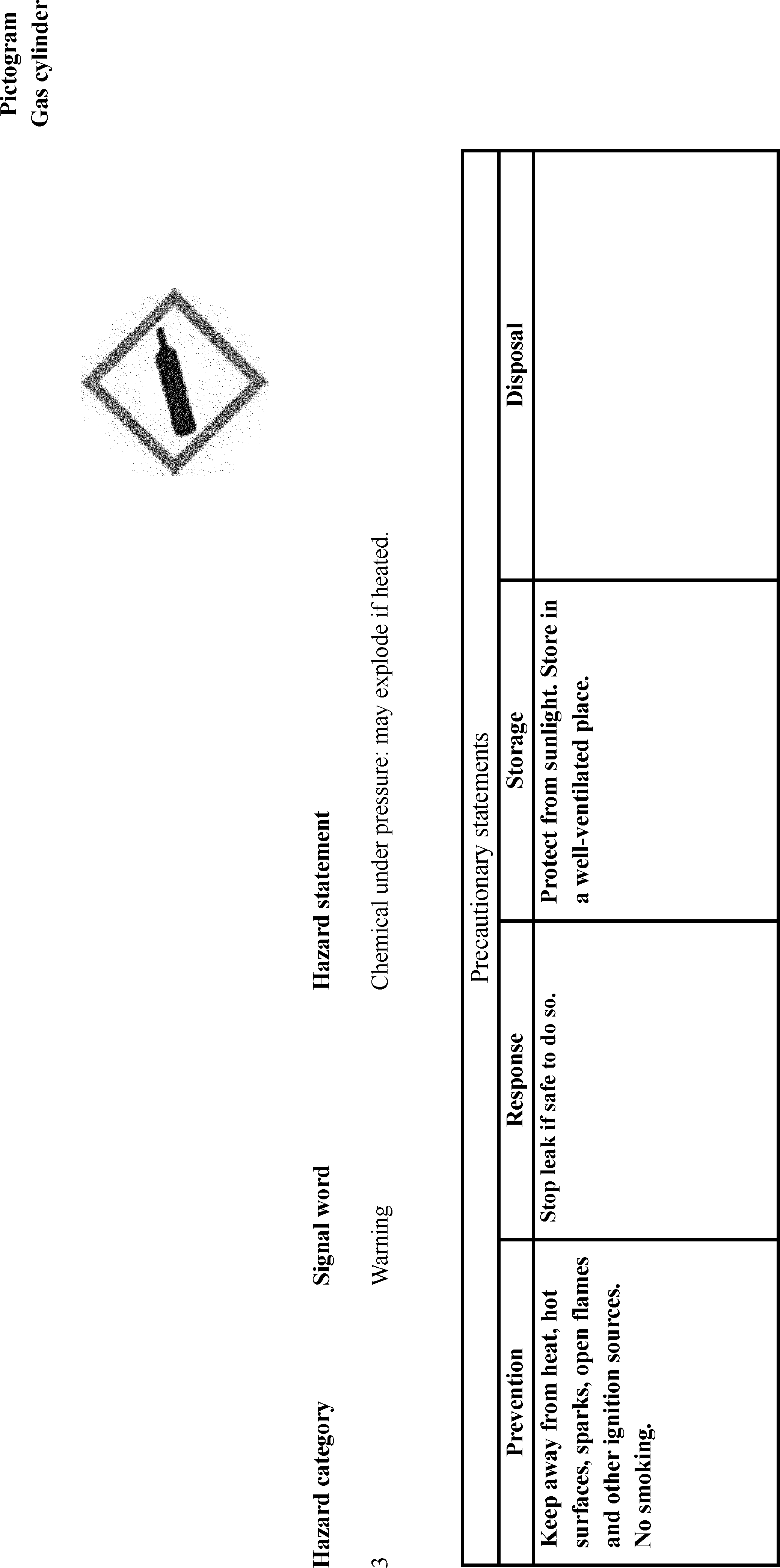
| On p. 44433-44434 | § 1910.1200, Appendix C, C.4.16 | Revise the tables for Chemical Under Pressure in C.4.16 to align with GHS Revision 8 hazard statements. For Category 1, revise hazard statement to read: “Extremely flammable chemical under pressure. May explode if heated.” For Category 2, revise hazard statement to read: “Flammable chemical under pressure. May explode if heated.” For Category 3, revise hazard statement to read: “Chemical under pressure: may explode if heated.” |
| On p. 44433 | § 1910.1200, Appendix C, C.4.16 | For Chemical Under Pressure Hazard Category 1 and Hazard Category 2, in the Response column, add: |
| “ In case of fire: Use . . . to extinguish. — |
||
| In the Response column, bold the font for “ In case of leakage, eliminate all ignition sources. ” and “ Stop leak if safe to do so. ” |
||
| On p. 44434 | § 1910.1200, Appendix C, C.4.16 | For Chemicals Under Pressure Hazard Category 3:
In the Response column, bold the font for “ |
| On p. 44438 | § 1910.1200, Appendix C, C.4.19 | For Hazard category 1, 2 and 3: Under the Prevention column, delete “Chemical manufacturer, importer, or distributor to specify applicable ignition source(s).” in the third line. |
| Under the Prevention column, remove the “/” from “Ground/and bond container and receiving equipment.” | ||
|
( printed page 565) |
||
| Under the Prevention column, bold the font in the statement “Use non-sparking tools.” |
||
| Under the Response column, remove the “/” from “/[or shower]”. | ||
| Under the Response column, remove the slash “/” from “/importer”. | ||
| On p. 44440 | § 1910.1200, Appendix C, C.4.20 | For Hazard category 1 and 2, under the Prevention column, remove the “/” from “Ground and/bond container and receiving equipment.” |
| On p. 44442 | § 1910.1200, Appendix C, C.4.21 | For Hazard category Type B, under the Storage column remove the bold font on “if temperature control is required” and italicize the font for “if temperature control is required (see Appendix B.2.3) or if otherwise deemed necessary”. |
| On p. 44442 | § 1910.1200, Appendix C, C.4.21 | For Hazard category Type B, in the Prevention column remove the “/” from “/sparks” and “/open flames”. |
| On p. 44443 | § 1910.1200, Appendix C, C.4.21 | For Hazard category Type C-F, in the Prevention column remove the “/” from “/sparks” and “/open flames”. |
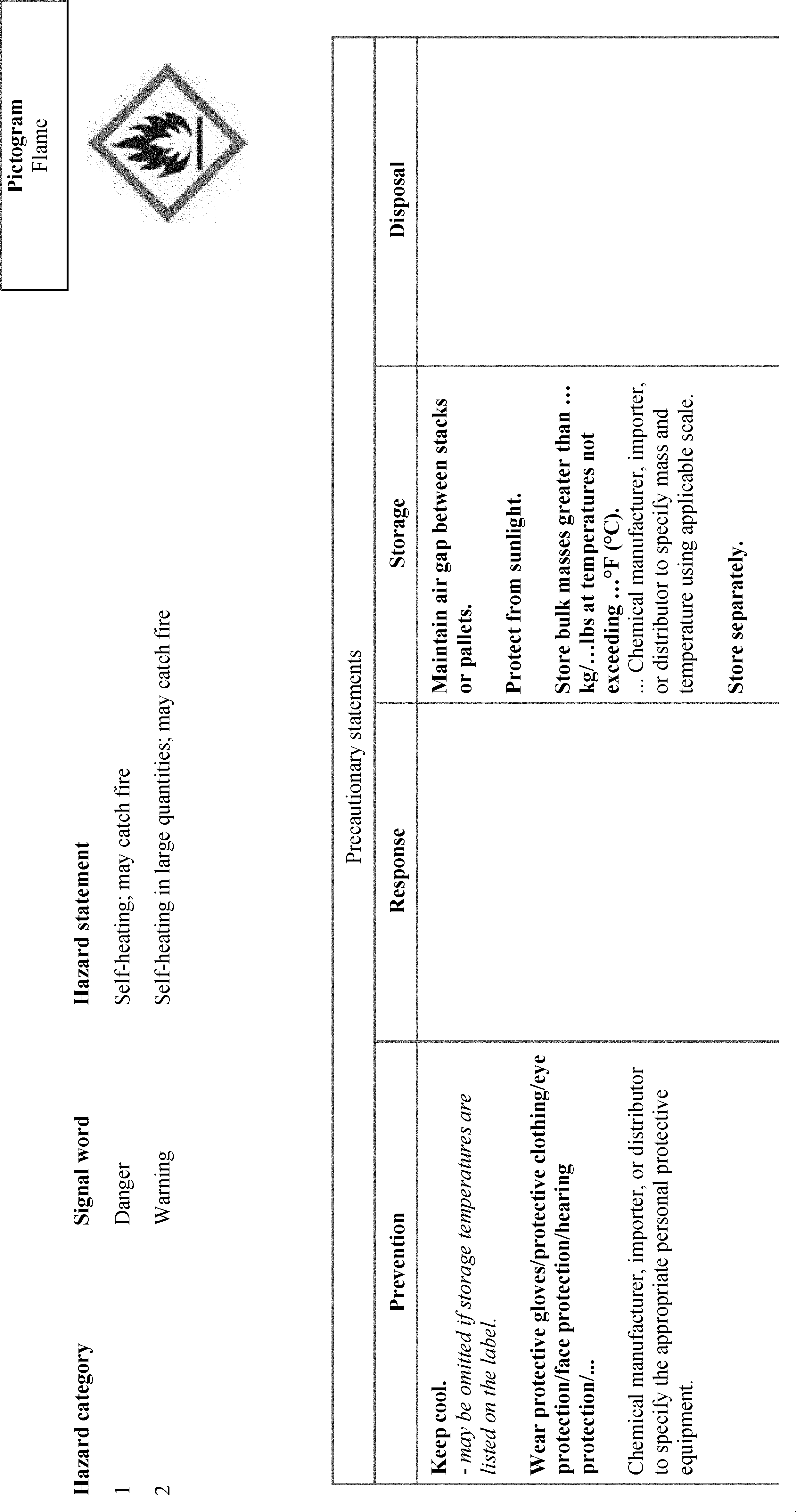
| On p. 44446 | § 1910.1200, Appendix C, C.4.24 | In the Storage column, remove the “/” from “stacks/” in the first line. |
| On p. 44458 | § 1910.1200, Appendix C, C.4.30 | For Hazard category 4, under the response column add the phrase “ and large quantities ” after “ In case of major fire ”. |
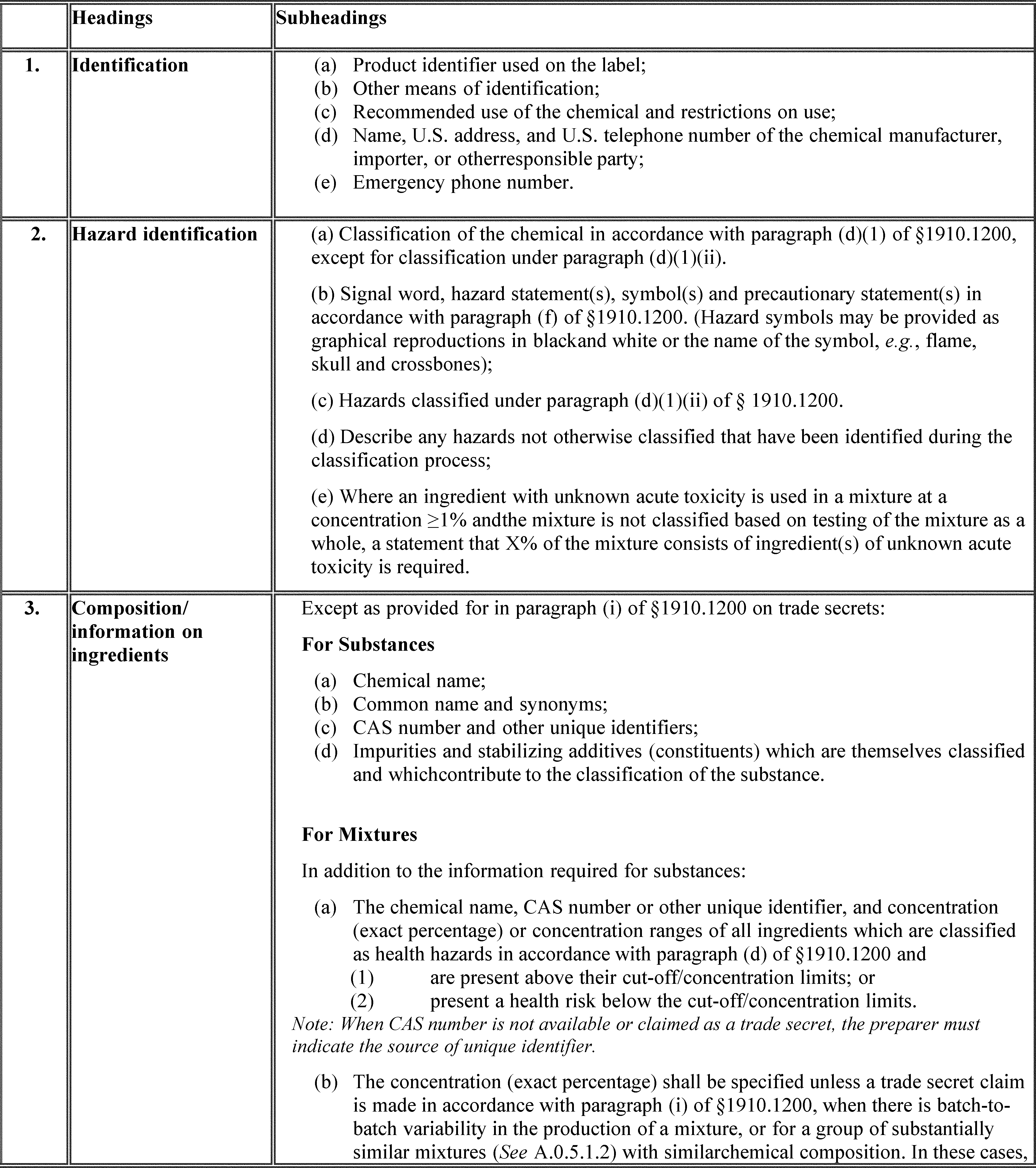
| On p. 44459 | § 1910.1200, Appendix D, Table D.1, Section 2 | In the Subheadings Column: In paragraph (a) of section 2 (Hazard Identification), change “(a) Classification of the chemical in accordance with paragraph (d)(1)(i) of § 1910.1200;” to read as “(a) Classification of the chemical in accordance with paragraph (d)(1) of § 1910.1200, except for classification under paragraph (d)(1)(ii).” |
| In paragraph (c) of section 2 (Hazard Identification), change “(c) Hazards classified under paragraph (d)(1)(ii) of § 1910.12000;” to read as “(c) Hazards classified under paragraph (d)(1)(ii) of § 1910.1200;”. | ||
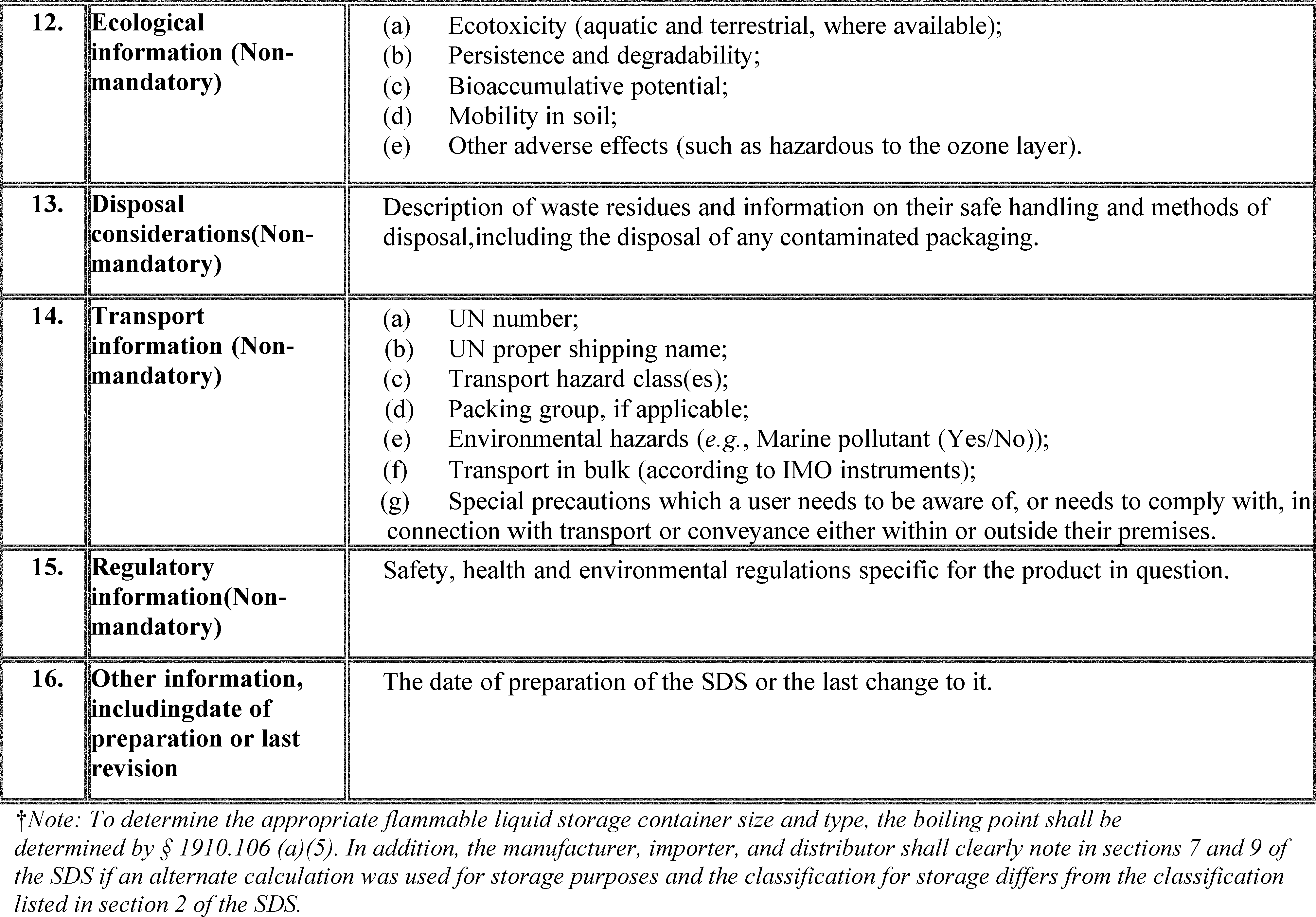
| On p. 44460 | § 1910.1200, Appendix D, Table D.1, Section 7 | In the Headings column, add the “dagger” (†) symbol after “7. Handling and Storage” to correspond with the note at the end of Appendix D. |

| On p. 44461 | § 1910.1200, Appendix D, Table D.1, Note | In the Note at the end of Table D.1, remove the phrases “methods specified under” and “and then listed on the SDS” from the first sentence. |
| 77 FR 17886 | § 1910.1200, Appendix F, Responses Are in One Sex or Both Sexes |
Change “gender-specific tumors” to “sex-specific tumors” in “Any case of gender-specific tumors should be evaluated in light of the total tumorigenic response to the substance observed at other sites (multi-site responses or incidence above background) in determining the carcinogenic potential of the substance.” |
|
1 Note that OSHA is also correcting the formatting of figures A.6.1, A.7.1(a), A.7.1(b), and A.8.1 as they appeared in the 2021 NPRM. |
||
II. Exemption From Notice-and-Comment Procedures
OSHA has determined that these corrections are not subject to the procedures for public notice and comment specified in Section 4 of the Administrative Procedures Act (5 U.S.C. 553) or Section 6(b) of the Occupational Safety and Health Act of 1970 (29 U.S.C. 655(b)). This rulemaking only corrects errors of a minor, mainly typographical nature and makes technical amendments that do not affect or change any existing rights or obligations, and no stakeholder is likely to object to these changes. Therefore, OSHA has determined that there is good cause that public notice and comment are unnecessary within the meaning of 5 U.S.C. 553(b)(4)(B), 29 U.S.C. 655(b), and 29 CFR 1911.5. For the same reasons, the Agency finds good cause under 5 U.S.C. 553(d)(3) to make the amendment effective upon publication.
III. Authority and Signature
David Keeling, Assistant Secretary of Labor for Occupational Safety and Health, authorized the preparation of this document. It is issued under the authority of sections 4, 6, and 8 of the Occupational Safety and Health Act of 1970 (29 U.S.C. 653, 655, 657); 5 U.S.C. 553; Section 304, Clean Air Act Amendments of 1990 (Pub. L. 101-549, reprinted at 29 U.S.C.A. 655 Note); Section 41, Longshore and Harbor Workers’ Compensation Act (33 U.S.C. 941); Section 107, Contract Work Hours and Safety Standards Act (40 U.S.C. 3704); Section 1031, Housing and Community Development Act of 1992 (42 U.S.C. 4853); Section 126, Superfund Amendments and Reauthorization Act of 1986, as amended (reprinted at 29 U.S.C.A. 655 Note); Secretary of Labor’s Order No. 07-2025 (90 FR 27878); and 29 CFR part 1911.
- Chemicals
- Diseases
- Explosives
- Flammable materials
- Gases
- Hazardous substances
- Incorporation by reference
- Labeling
- Occupational safety and health
- Safety
- Signs and symbols
Signed at Washington, DC, on January 5, 2026.
David Keeling,
Assistant Secretary of Labor for Occupational Safety and Health.
Accordingly, 29 CFR part 1910 is corrected by making the following correcting amendments:
1. The authority citation for part 1910 is revised to read as follows:
33 U.S.C. 941; 29 U.S.C. 653, 655, 657; Secretary of Labor’s Order No. 12-71 (36 FR 8754); 8-76 (41 FR 25059), 9-83 (48 FR 35736), 1-90 (55 FR 9033), 6-96 (62 FR 111), 3-2000 (65 FR 50017), 5-2002 (67 FR 65008), 5-2007 (72 FR 31160), 4-2010 (75 FR 55355), 1-2012 (77 FR 3912), 08-2020 (85 FR 58393), or 07-2025 (90 FR 27878); 29 CFR part 1911; and 5 U.S.C. 553, as applicable.
2. Amend § 1910.6 by revising paragraph (h) introductory text and paragraph (h)(27) to read as follows:
Incorporation by reference.
* * * * *
(h) ASTM International, 100 Barr Harbor Drive, P.O. Box C700, West Conshohocken, PA 19428-2959; phone: (610) 832-9585; email:
service@astm.org;
website:
www.astm.org.
* * * * *
(27) ASTM D4359-90 (Reapproved 2019), Standard Test Method for Determining Whether a Material is a Liquid or a Solid, approved July 1, 2019, IBR approved for § 1910.1200.
* * * * *
3. Amend § 1910.1200 as follows:
( printed page 566)
a. In paragraph (c):
i. Add a heading to the paragraph.
ii. Revise the definitions of “Liquid,” “Physical hazard,” and “Work area”.
b. Add a heading to paragraph (d).
c. In appendix A:
i. Revise and republish Figure A.1.1.
ii. Revise paragraphs A.2.2, A.2.2.3.3.1, and A.2.2.3.4.1.
iii. Revise and republish Figures A.6.1, A.7.1(a), A.7.1.(b), and A.8.1 and Table A.10.1.
d. In appendix B:
i. Revise and republish Tables B.2.1, B.3.1, and B.3.2.
ii. Revise paragraph B.3.3.3.
iii. Revise and republish Tables B.5.1 and B.6.1.
iv. In section B.6.3, in the second paragraph, redesignate footnote 9 as footnote 1.
v. Revise and republish Table B.7.1.
vi. In section B.17.1, in the definition of “Desensitized explosives,” redesignate footnotes 10 and 11 as footnotes 2 and 3.
e. In appendix C:
i. Revise and republish Figure C.1.
ii. Revise paragraph C.2.4.6.
iii. Revise and republish Tables C.4.10, C.4.14, C.4.16, C.4.19, C.4.20, C.4.21, C.4.24, and C.4.30.
f. Revise and republish appendix D.
g. In appendix F, revise Responses Are in One Sex or Both Sexes.
The revisions read as follows:
Hazard communication.
* * * * *
(c)
Definitions.
* * *
Liquid
means a substance or mixture which at 122 °F (50 °C) has a vapor pressure of not more than 43.51 PSI (300 kPa (3 bar)), which is not completely gaseous at 68 °F (20 °C) and at a standard pressure of 14.69 PSI (101.3 kPa), and which has a melting point or initial melting point of 68 °F (20 °C) or less at a standard pressure of 14.69 PSI (101.3 kPa). Either ASTM D 4359-90 (R2019) (incorporated by reference, see § 1910.6); or the test for determining fluidity (penetrometer test) prescribed in section 2.3.4 of ADR 2019 (incorporated by reference, see § 1910.6) can establish whether a viscous substance or mixture is a liquid if a specific melting point cannot be determined.
* * * * *
Physical hazard
means a chemical that is classified as posing one of the following hazardous effects: explosive, flammable (gases, liquids, or solids); aerosols; chemical under pressure; oxidizer (gases, liquids, or solids); self-reactive; pyrophoric (liquid or solid); self-heating; organic peroxide; corrosive to metal; gas under pressure; in contact with water emits flammable gas; or desensitized explosive. The criteria for determining whether a chemical is classified as a physical hazard are detailed in appendix B to this section.
* * * * *
Work area
means a room or defined space in a workplace where hazardous chemicals are produced or used, and where employees are present.
* * * * *
(d)
Hazard classification.
* * *
Appendix A to § 1910.1200 Health Hazard Criteria (Mandatory)
* * * * *
Figure A.1.1: Tiered Approach to Classification of Mixtures for Acute Toxicity
* * * * *
A.2.2 Classification Criteria for Substances
Substances shall be allocated to one of the following categories within this hazard class:
(a) Category 1 (Skin Corrosion)
This category may be further divided into up to three sub-categories (1A, 1B, and 1C).
( printed page 567)
Corrosive substances should be classified in Category 1 where data are not sufficient for sub-categorization.
When data are sufficient, substances may be classified in one of the three sub-categories 1A, 1B, or 1C.
(b) Category 2 (Skin Irritation)
* * * * *
A.2.2.3.3.1 Where tests have been undertaken in accordance with OECD Test Guidelines (TGs) 430, 431, or 435, a substance is classified for skin corrosion in category 1 (and, where possible and required into sub-categories 1A, 1B, or 1C).
* * * * *
A.2.2.3.4.1 Where a conclusion of corrosivity can be excluded and where tests have been undertaken in accordance with OECD Test Guideline 439, a substance is classified for skin irritation in category 2.
* * * * *
Figure A.6.1: Hazard Categories for Carcinogens
* * * * *
( printed page 568)
Figure A.7.1(a): Hazard Categories for Reproductive Toxicants
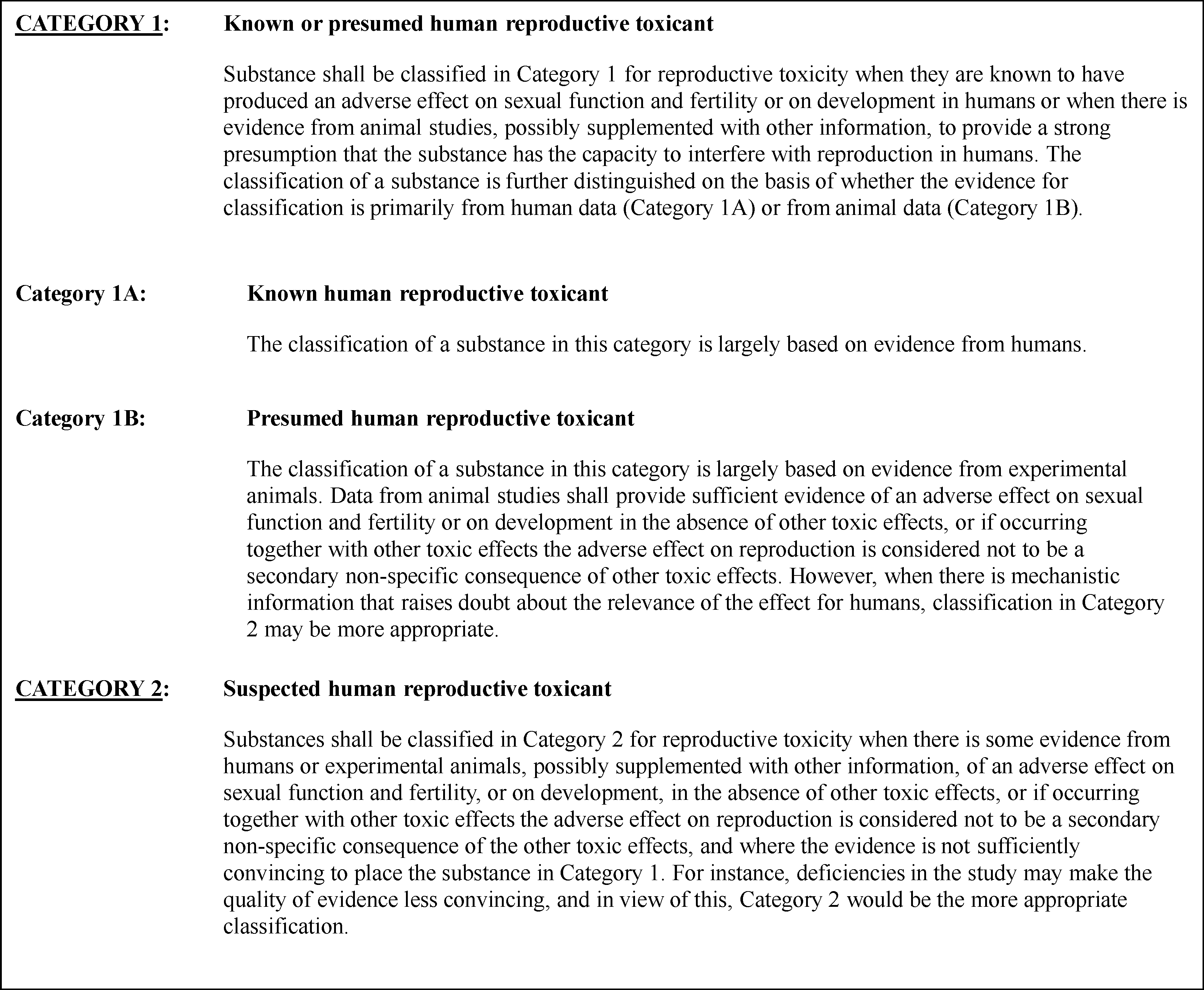
Figure A.7.1(b): Hazard Category for Effects On or Via Lactation
* * * * *
( printed page 569)
Figure A.8.1: Hazard Categories for Specific Target Organ Toxicity Following Single Exposure
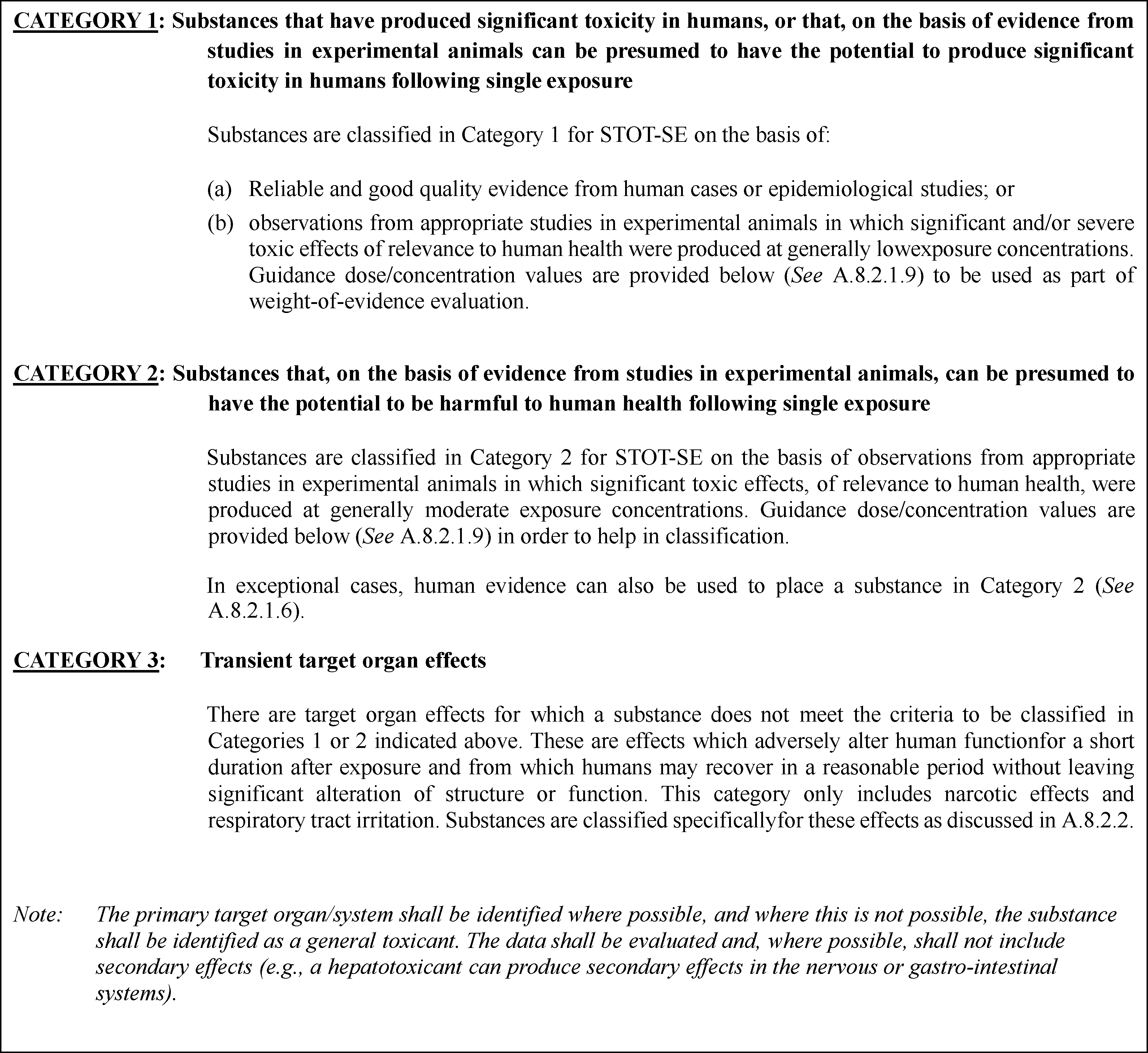
Table A.10.1: Criteria for Aspiration Toxicity
* * * * *
( printed page 570)
Appendix B to § 1910.1200—Physical Hazard Criteria (Mandatory)
* * * * *
Table B.2.1: Criteria for Flammable Gases
* * * * *
( printed page 571)
Table B.3.1: Criteria for Aerosols
* * * * *
( printed page 572)
Table B.3.2: Criteria for Chemicals Under Pressure
* * * * *
B.3.3.3 The chemical heats of combustion shall be found in literature, calculated or determined by tests: (see ASTM D 240-02; Sections 86.1 to 86.3 of ISO 13943; and NFPA 30B (incorporated by reference, see § 1910.6)).
* * * * *
Table B.5.1: Criteria for Gases Under Pressure
* * * * *
( printed page 573)
Table B.6.1: Criteria for Flammable Liquids
* * * * *
Table B.7.1: Criteria for Flammable Solids
* * * * *
( printed page 574)
Appendix C to § 1910.1200—Allocation of Label Elements (Mandatory)
* * * * *
Figure C.1—Hazard Symbols and Classes
* * * * *
C.2.4.6 Precautionary statements may be combined or consolidated to save label space and improve readability. For example, “Keep cool” and “Keep away from heat, hot surfaces, sparks, open flames and other ignition sources. No smoking.” can be combined to read “Keep cool and away from heat, hot surfaces, sparks, open flames and other ignition sources. No smoking.”
* * * * *
C.4.10 REPRODUCTIVE TOXICITY
(Classified in Accordance with Appendix A.7 of this section)
( printed page 575)
C.4.10 REPRODUCTIVE TOXICITY (CONTINUED)
(Classified in Accordance with Appendix A.7 of this section)
(EFFECTS ON OR VIA LACTATION)
( printed page 576)
* * * * *
C.4.14 EXPLOSIVES
(Classified in Accordance with Appendix B.1 of this section)
( printed page 577)
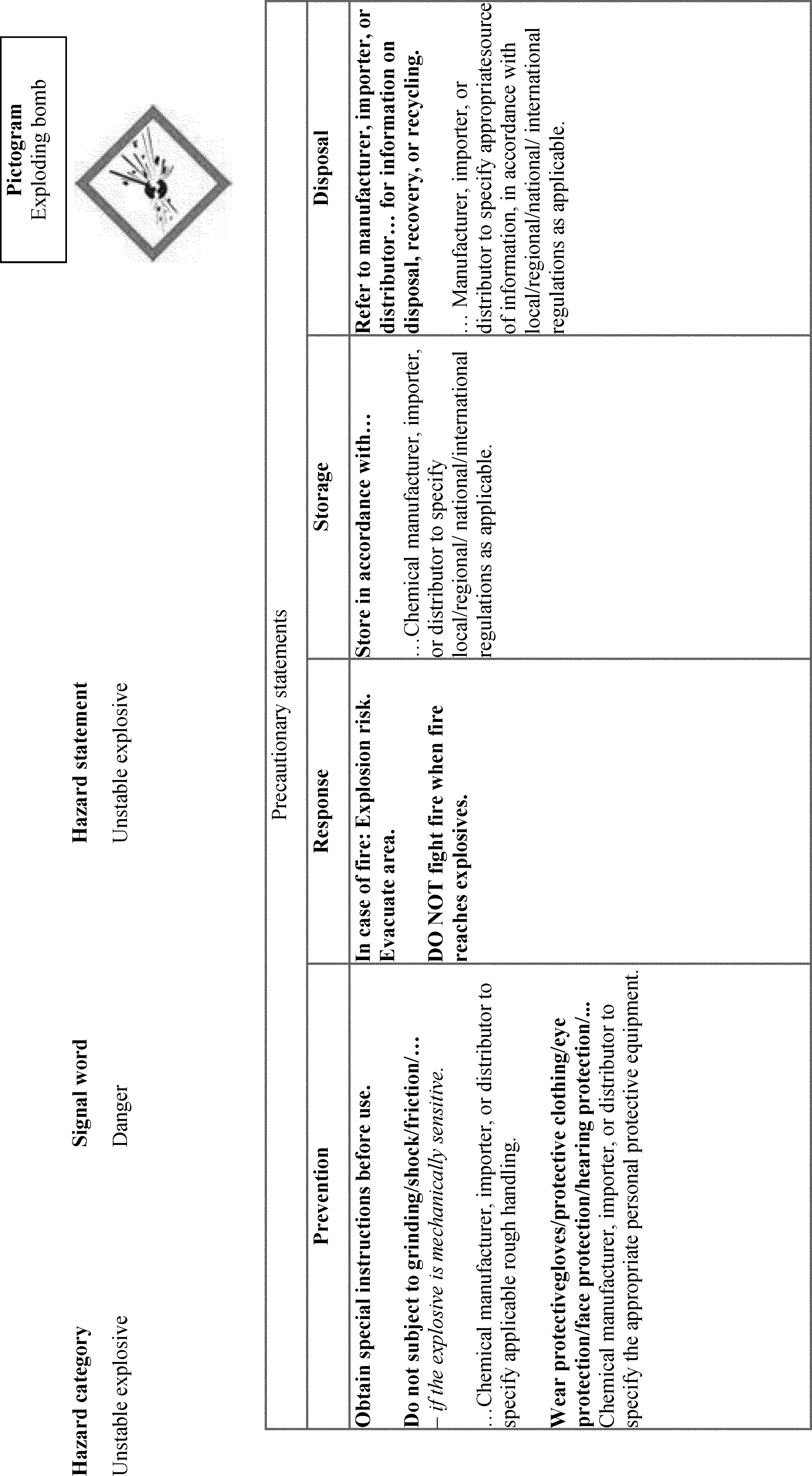
C.4.14 EXPLOSIVES (CONTINUED)
(Classified in Accordance with Appendix B.1 of this section)
( printed page 578)
( printed page 579)
C.4.14 EXPLOSIVES (CONTINUED)
(Classified in Accordance with Appendix B.1 of this section)
( printed page 580)
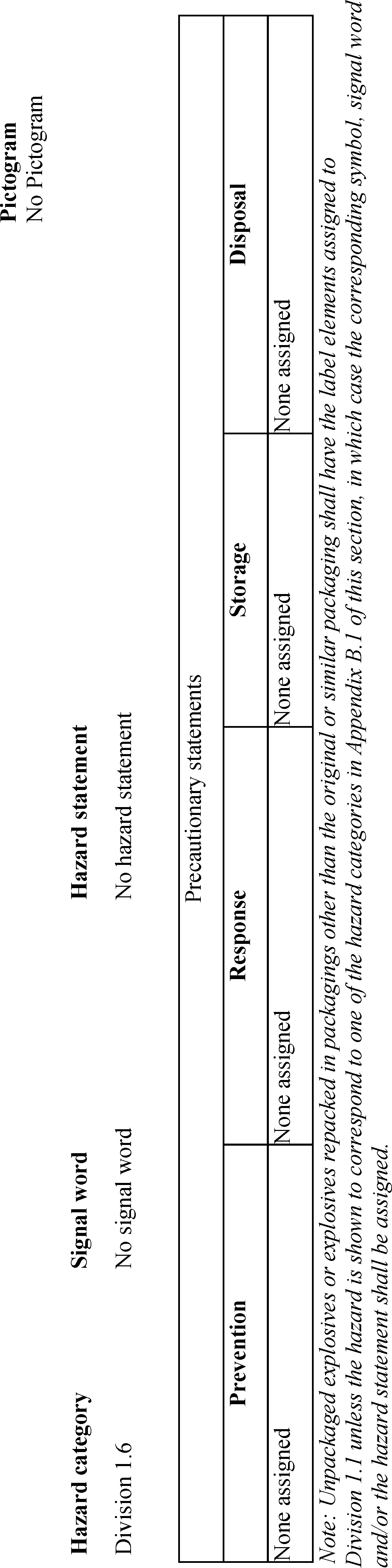
C.4.14 EXPLOSIVES (CONTINUED)
(Classified in Accordance with Appendix B.1 of this section)
C.4.14 EXPLOSIVES (CONTINUED)
(Classified in Accordance with Appendix B.1 of this section)
( printed page 581)
* * * * *
C.4.16 AEROSOLS
(Classified in Accordance with Appendix B.3 of this section)
( printed page 582)
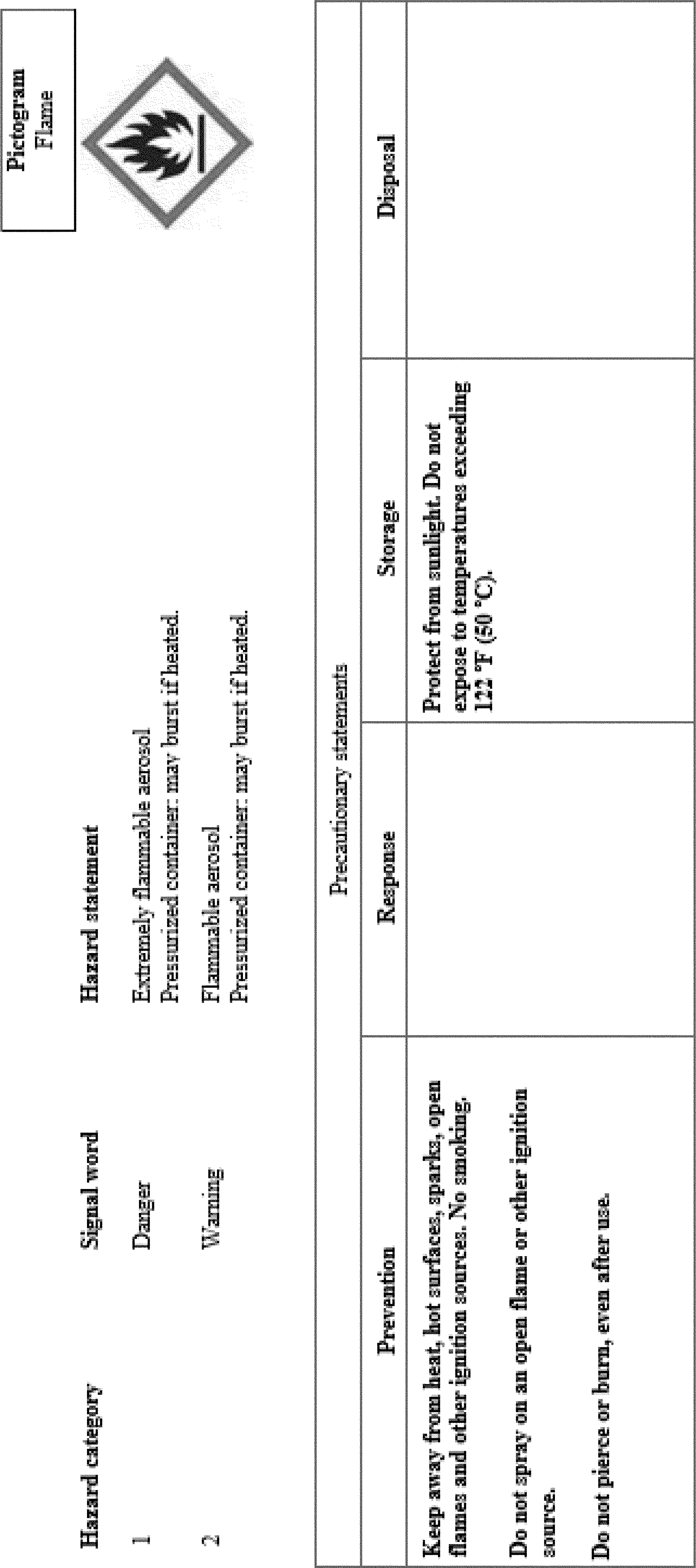
C.4.16 AEROSOLS
(Classified in Accordance with Appendix B.3.1 of this section)
( printed page 583)
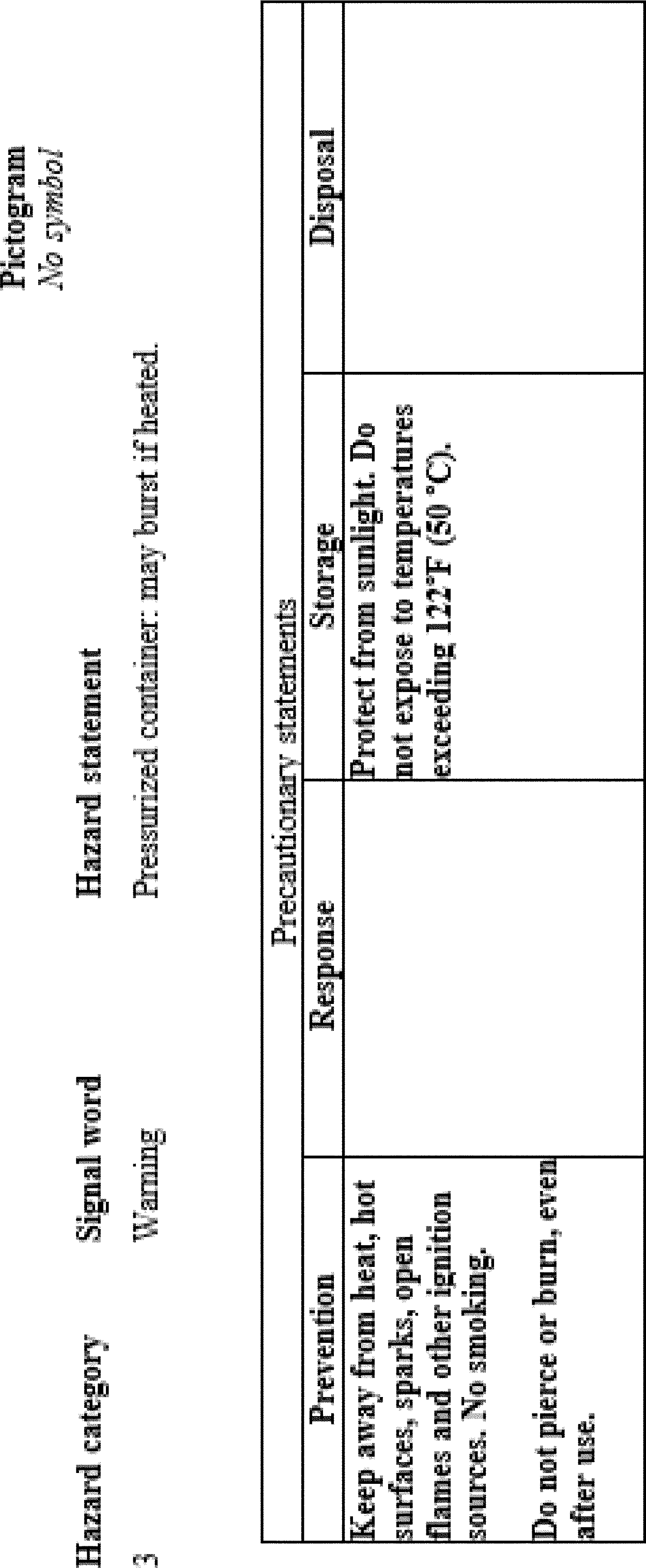
C.4.16 CHEMICAL UNDER PRESSURE
(Classified in Accordance with Appendix B.3.2 of this section)
( printed page 584)
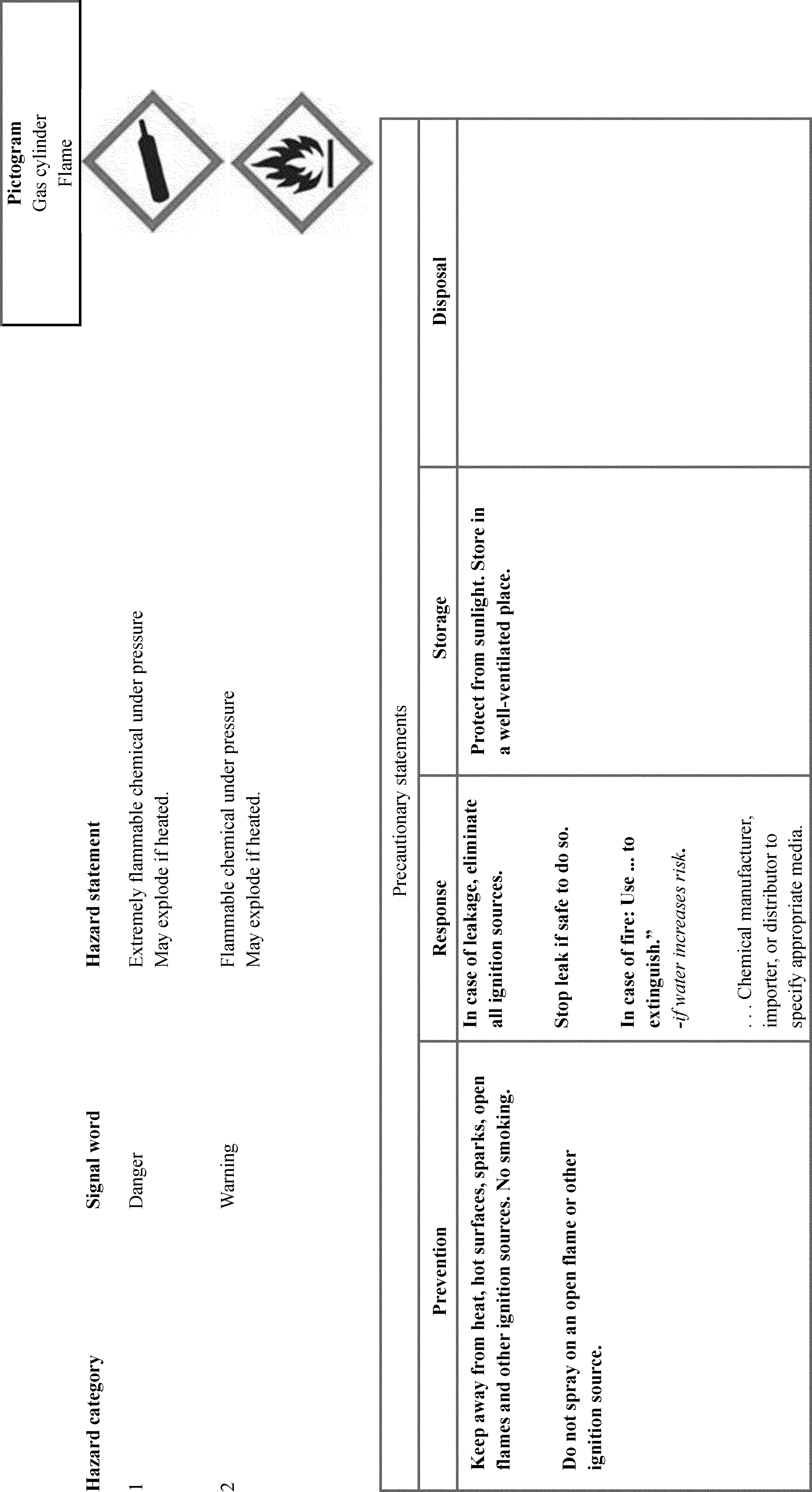
C.4.16 CHEMICAL UNDER PRESSURE
(Classified in Accordance with Appendix B.3 of this section)
( printed page 585)
* * * * *
C.4.19 FLAMMABLE LIQUIDS
(Classified in Accordance with Appendix B.6 of this section)
( printed page 586)
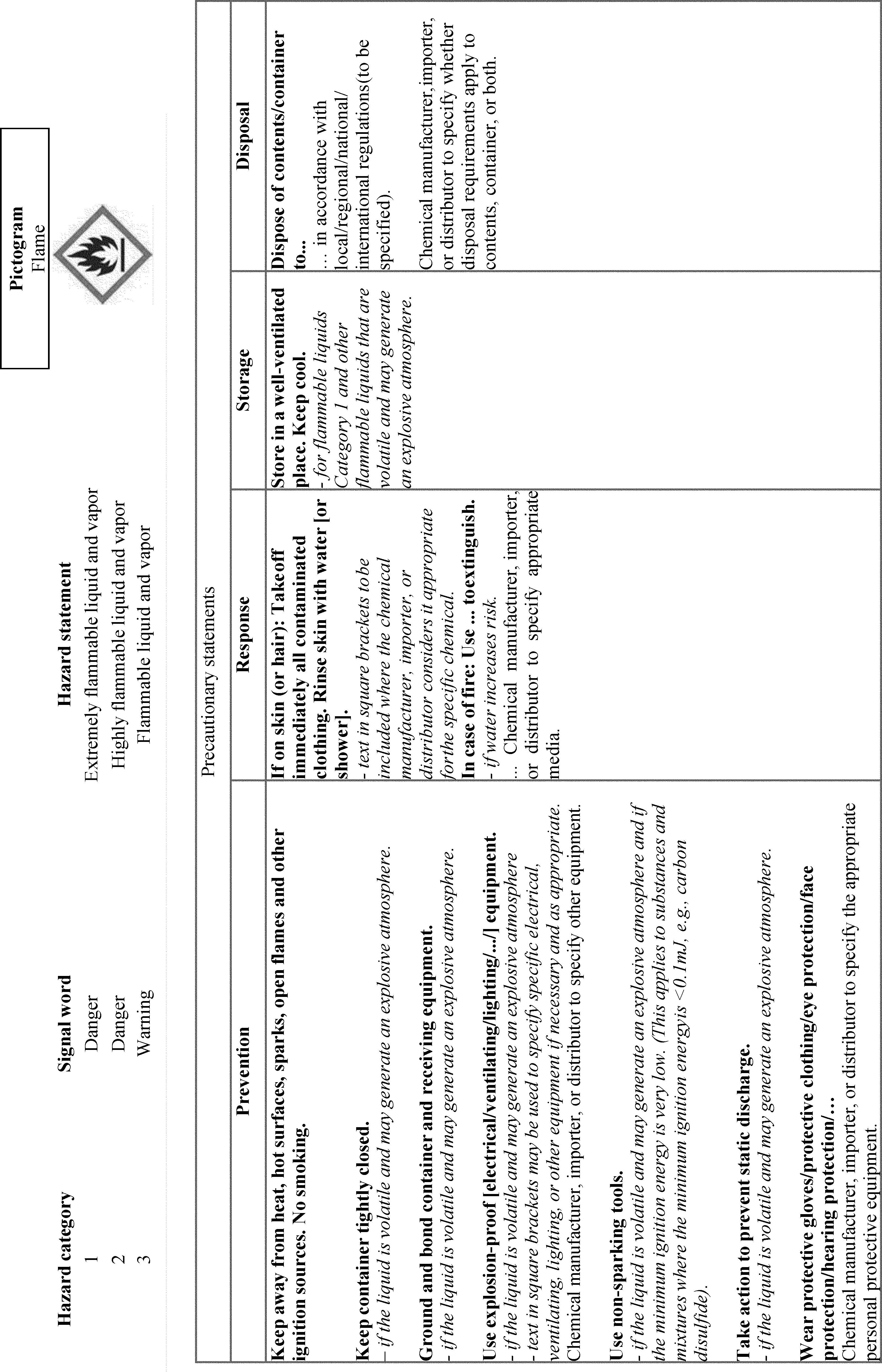
C.4.19 FLAMMABLE LIQUIDS (CONTINUED)
(Classified in Accordance with Appendix B.6 of this section)
( printed page 587)
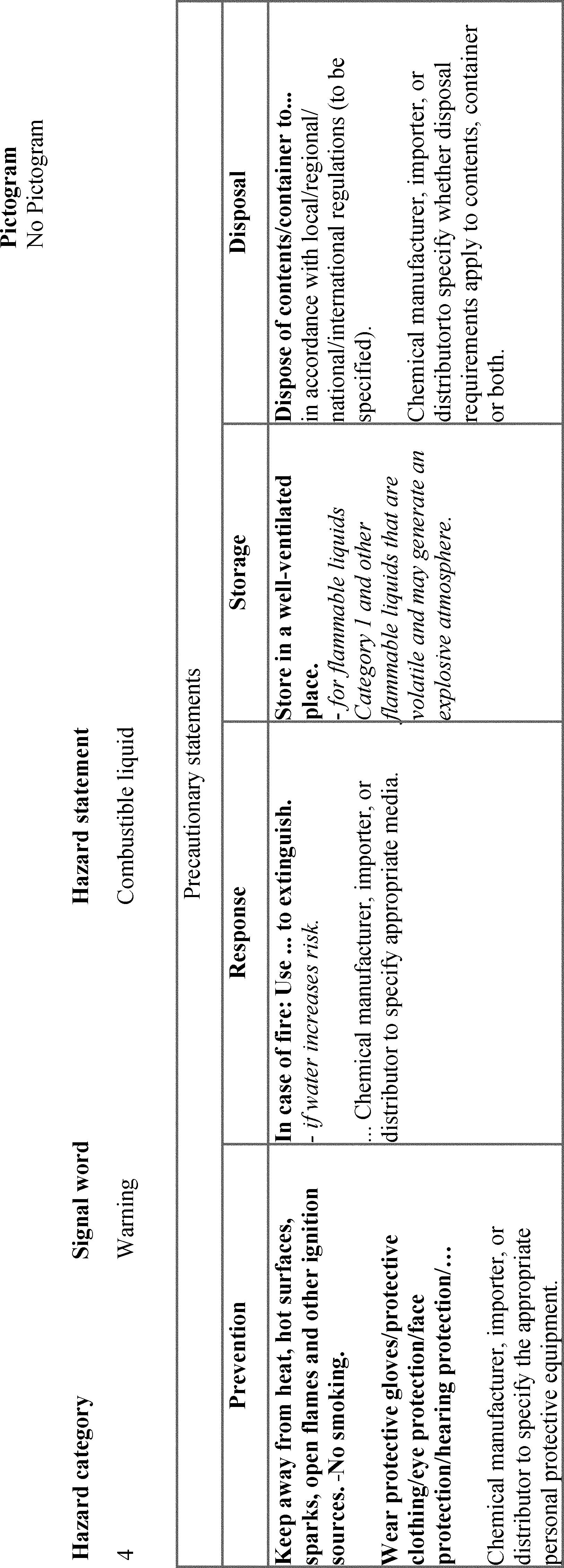
C.4.20 FLAMMABLE SOLIDS
(Classified in Accordance with Appendix B.7 of this section)
( printed page 588)
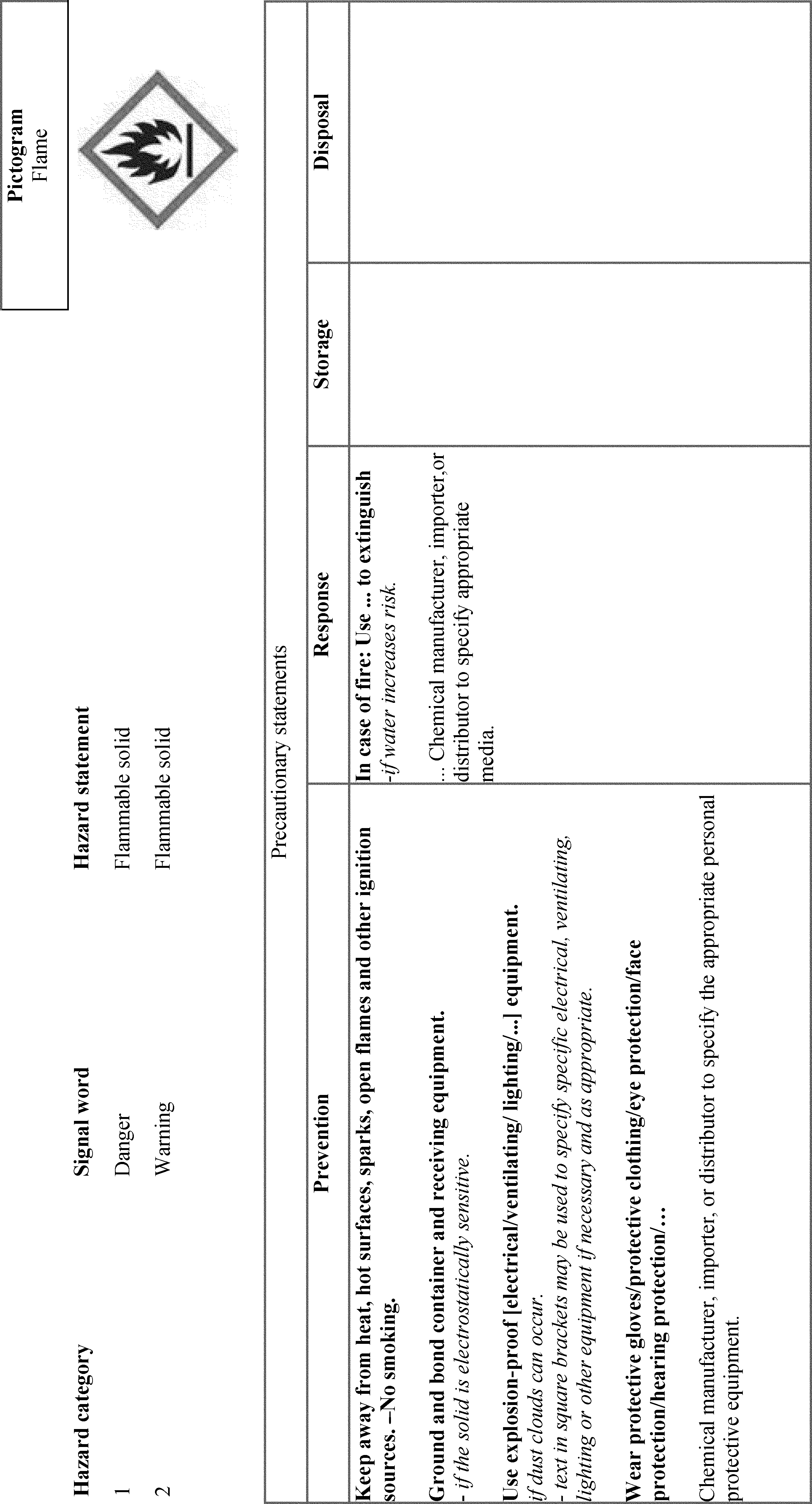
C.4.21 SELF-REACTIVE SUBSTANCES AND MIXTURES
(Classified in Accordance with Appendix B.8 of this section)
( printed page 589)
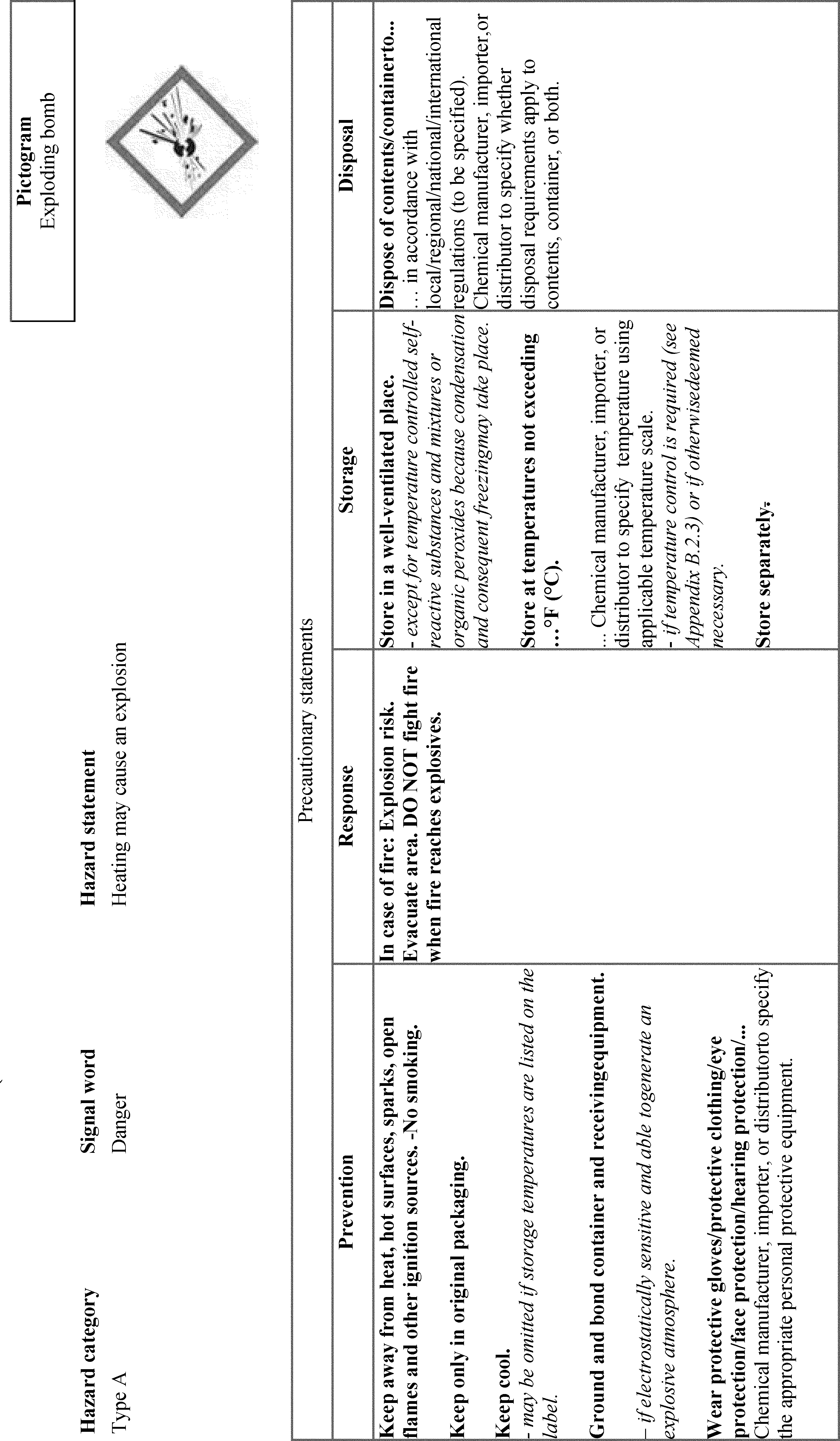
C.4.21 SELF-REACTIVE SUBSTANCES AND MIXTURES (CONTINUED)
(Classified in Accordance with Appendix B.8 of this section)
( printed page 590)
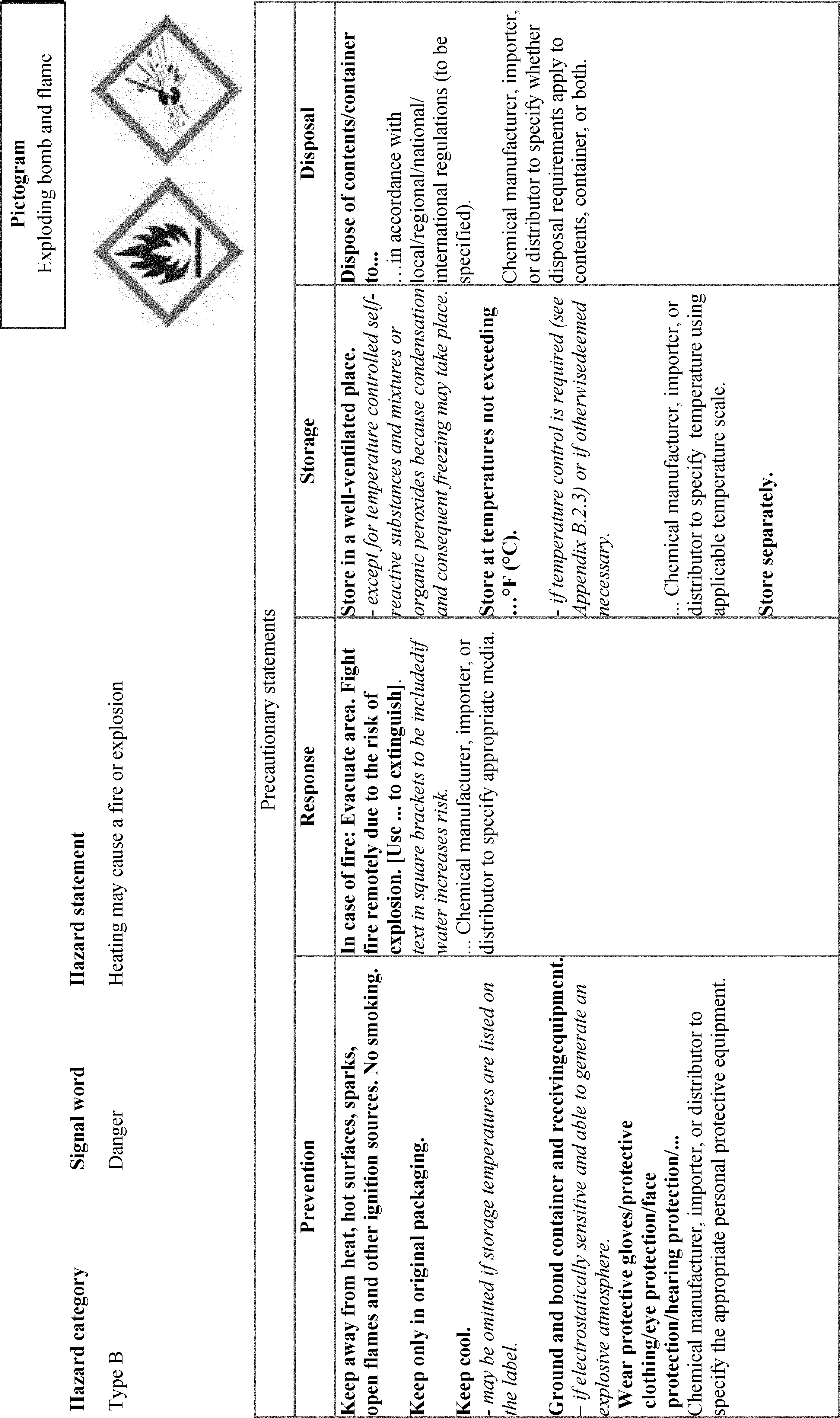
C.4.21 SELF-REACTIVE SUBSTANCES AND MIXTURES (CONTINUED)
(Classified in Accordance with Appendix B.8 of this section)
( printed page 591)
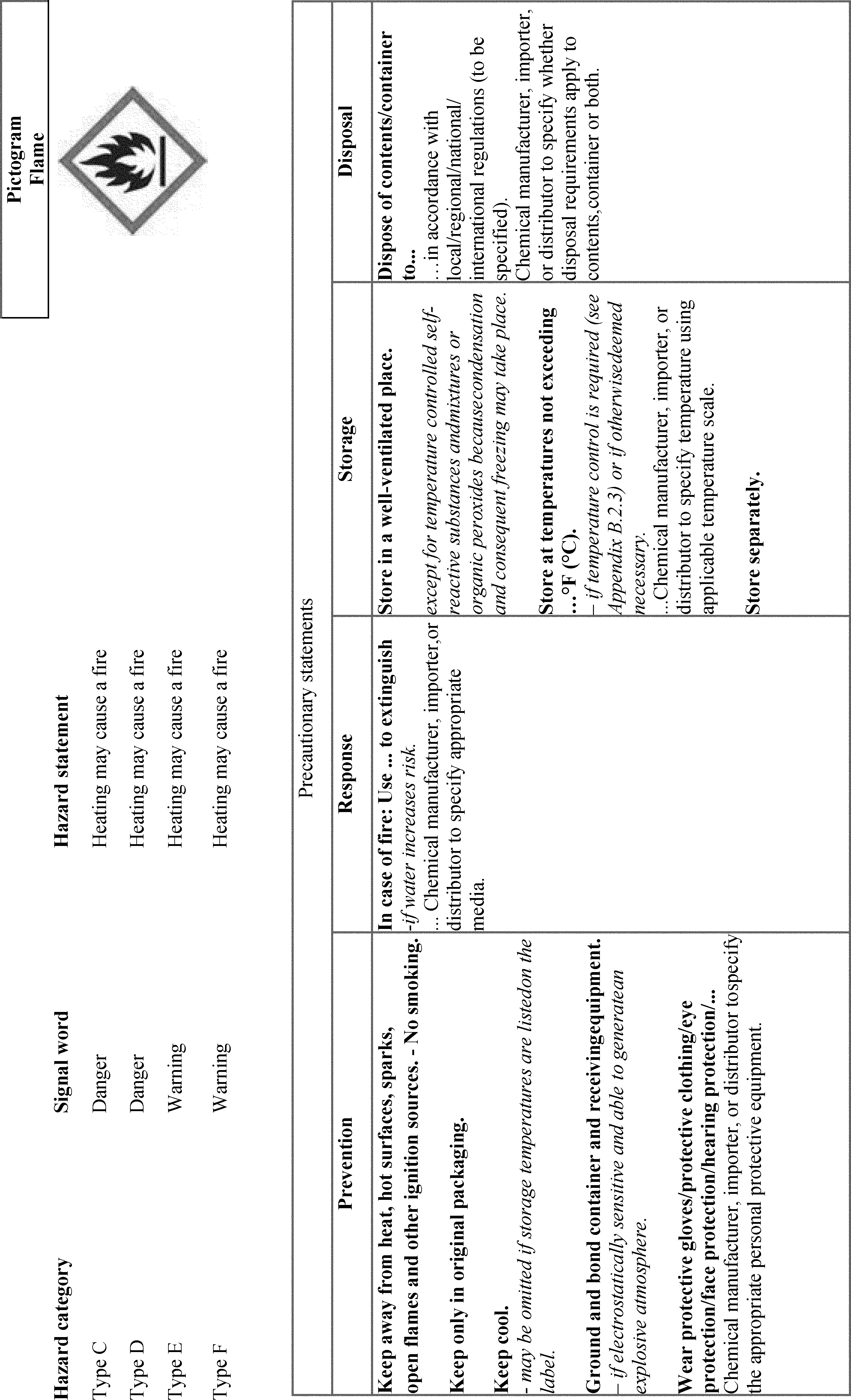
* * * * *
C.4.24 SELF-HEATING SUBSTANCES AND MIXTURES
(Classified in Accordance with Appendix B.11 of this section)
( printed page 592)
* * * * *
C.4.30 DESENSITIZED EXPLOSIVES
(Classified in Accordance with Appendix B.17 of this section)
( printed page 593)
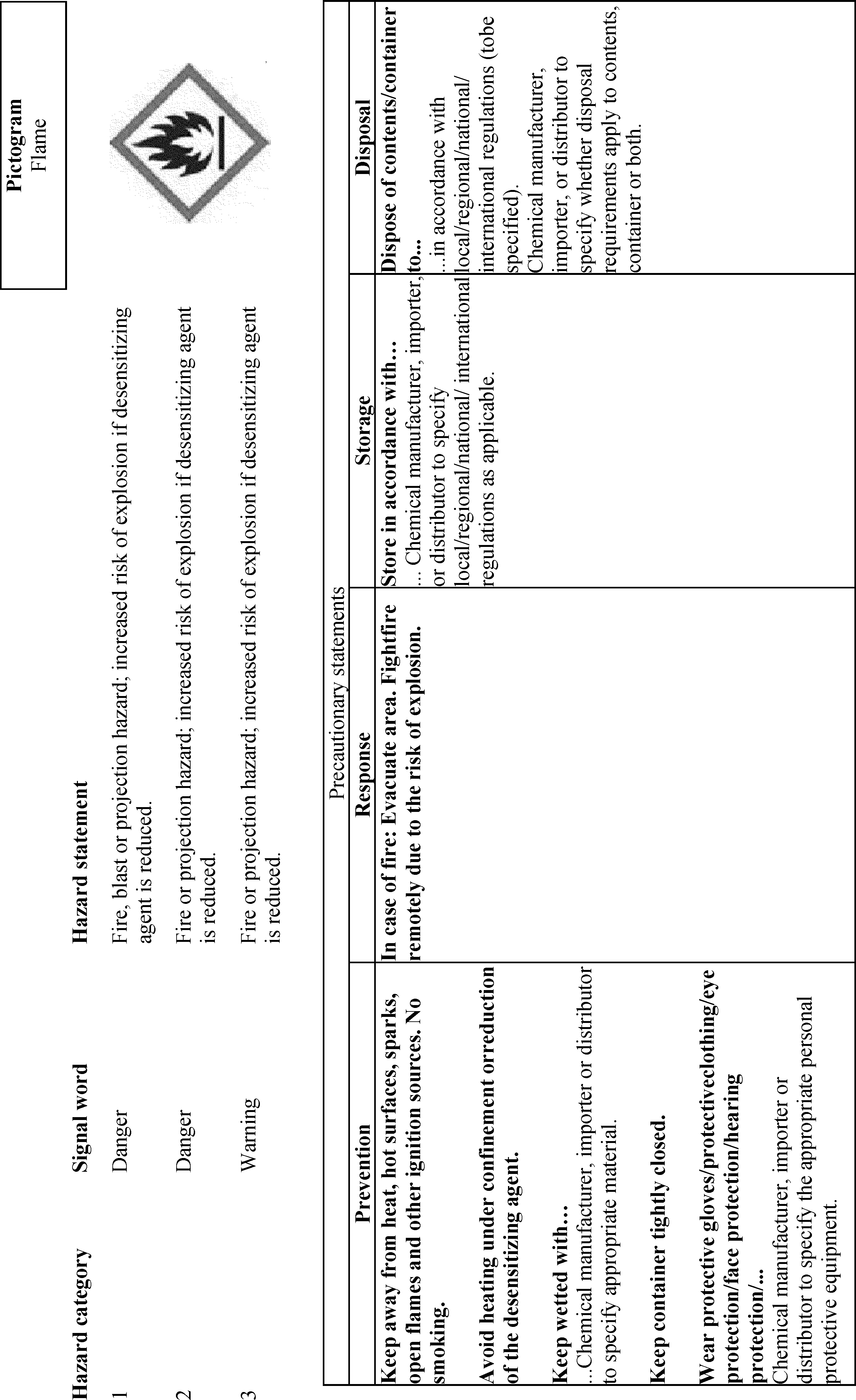
C.4.30 DESENSITIZED EXPLOSIVES
(Classified in Accordance with Appendix B.17 of this section)
( printed page 594)
* * * * *
Appendix D to § 1910.1200 Safety Data Sheet (Mandatory)
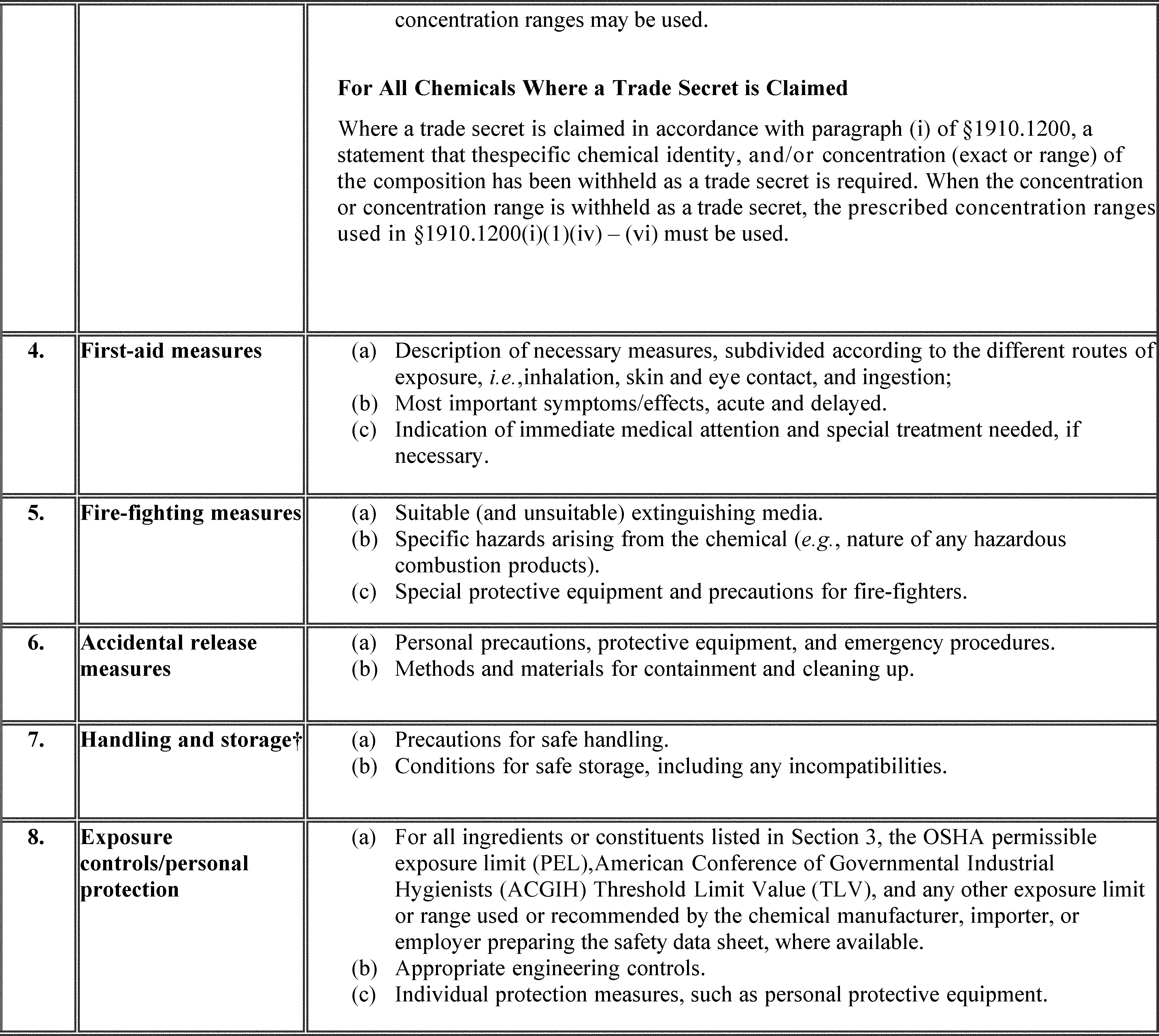
A safety data sheet (SDS) shall include the information specified in Table D.1 under the section number and heading indicated for sections 1-11 and 16. While each section of the SDS must contain all of the specified information, preparers of safety data sheets are not required to present the information in any particular order within each section. If no relevant information is found for any given subheading within a section, the SDS shall clearly indicate that no applicable information is available. Sections 12-15 may be included in the SDS, but are not mandatory.
( printed page 595)
Table D.1. Minimum Information for an SDS
( printed page 596)
( printed page 597)
( printed page 598)
* * * * *
Appendix F to § 1910.1200—Guidance for Hazard Classifications Re: Carcinogenicity (Non-Mandatory)
* * * * *
Responses Are in One Sex or Both Sexes
Any case of sex-specific tumors should be evaluated in light of the total tumorigenic response to the substance observed at other sites (multi-site responses or incidence above background) in determining the carcinogenic potential of the substance.
If tumors are seen only in one sex of an animal species, the mode of action should be carefully evaluated to see if the response is consistent with the postulated mode of action. Effects seen only in one sex in a test species may be less convincing than effects seen in both sexes, unless there is a clear patho-physiological difference consistent with the mode of action to explain the single sex response.
* * * * *
Author

harrywilliams031@gmail.com
Related Posts

어버이날이 가까워졌습니다. 그녀가 좋아할 50가지가 넘는 사려 깊은 선물을 확인해 보세요.
어버이날이 가까워졌습니다. 그녀가 좋아할 50가지가 넘는 사려 깊은 선물을 확인해 보세요. Source link
Read out all
휘트마이어 시장이 추위 속 안전을 강조하면서 휴스턴 지역에 또 다른 쓰라린 밤이 다가오고 있습니다.
휴스턴 – 존 휘트마이어 시장과 휴스턴 시 비상관리국은 지역 전체에 걸쳐 영하의 날씨가 계속됨에 따라 일요일 아침 휴스턴 시민들에게 밤샘 업데이트를 제공했습니다....
Read out all
Moelis India의 Girotra, 민간 신용 급증, AI 투자, 데이터 센터 거래 급증
Moelis India의 Manisha Girotra 최고경영자(CEO)는 “인도의 민간 부채 시장이 빠르게 성장하고 있다”고 말했습니다. 박하. 그는 민간부채는 한도표에서 더 유연하기 때문에 개인의 위험...
Read out all
영하의 체감온도로 디트로이트 메트로 지역의 동상, 저체온증 우려 제기
디트로이트 – 응급실 의사들은 위험한 영하의 기온이 디트로이트 메트로 지역을 계속 강타함에 따라 주민들에게 동상과 저체온증의 위험이 증가한다고 경고하고 있습니다. DMC 의사인...
Read out all
ED는 온라인 게임 앱 WinZO에 청구서를 제출하고 플레이어가 봇을 사용하여 ₹734 crore에 달하는 사기 행위를 했다고 비난합니다. Company Business News
집행국은 일요일에 실제 현금 온라인 게임 앱인 WinZO와 그 프로모터를 상대로 고소장을 제출했다고 밝혔으며 손실은 플레이어에게 있습니다. ₹회사는 게임의 알고리즘을 “조작”하고 Rs...
Read out all